
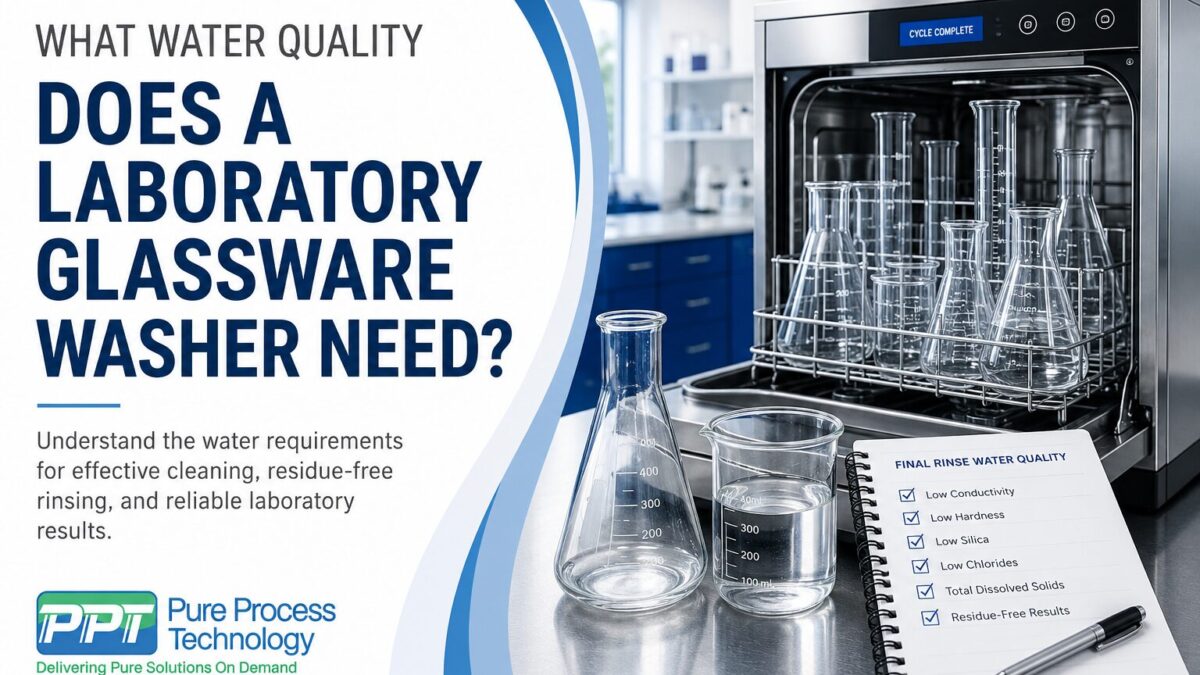
Laboratory glassware washers do more than remove visible residue. The cleaning process also needs to leave glassware suitable for the testing, research, production, or preparation that comes next.
That makes water quality an important part of washer performance.
Tap water may be acceptable for certain wash stages, but dissolved minerals, hardness, salts, silica, and other contaminants can remain behind after the water evaporates. For many laboratory applications, purified water is used during the final rinse to reduce spotting and prevent unwanted residue from being deposited back onto clean glassware.
The correct water quality depends on the washer manufacturer, the laboratory application, the contaminants being removed, and how clean the glassware needs to be after the cycle.
Does a Laboratory Glassware Washer Need Purified Water?
Often, particularly for the final rinse.
Many laboratory washers use different water qualities during different portions of the cleaning cycle. Incoming tap water may be suitable for an initial wash or rinse, then RO or DI water may be used for one or more final rinses.
This approach can reduce purified-water consumption without sacrificing final rinse quality.
The goal is not necessarily to run every stage of the cycle on the highest-purity water available. The goal is to prevent the final rinse from introducing contaminants that remain on the glassware.
Facilities that need purified water for washers and other lab equipment can review PPT’s complete range of high-purity water purification systems.
Why Does Water Quality Matter When Washing Laboratory Glassware?
Water contains substances that can remain behind after drying.
Depending on local feedwater conditions, these may include:
- Calcium
- Magnesium
- Chlorides
- Silica
- Dissolved salts
- Metals
- Particles
- Organic contaminants
When untreated water dries on glassware, dissolved material can remain on the surface.
This may appear as visible spotting or film, but not every residue is easy to see. For laboratories performing sensitive analytical work, trace contamination may create a larger problem than cosmetic water spots.
Hardness and Mineral Deposits
Hard water contains elevated concentrations of calcium and magnesium.
These minerals can form deposits on:
- Glassware
- Washer chambers
- Heating elements
- Spray arms
- Piping
- Nozzles
Over time, scale can also reduce washer performance and increase maintenance requirements.
Pretreatment such as softening may be used to reduce hardness before the water reaches the washer or downstream purification equipment.
If a facility is dealing with rising maintenance needs or inconsistent water quality from an existing system, PPT also provides water purification system service and preventative maintenance.
Why Is Purified Water Commonly Used for the Final Rinse?
The final rinse is the last water that contacts the glassware before drying.
Any dissolved contaminants in that water may remain after evaporation.
Using purified water during the final rinse can reduce:
- Mineral spotting
- Dissolved solids
- Ionic contamination
- Residue
- Variability between wash cycles
The required purity depends on what the cleaned glassware will be used for.
General laboratory glassware may not require the same final-rinse quality as glassware used for trace analysis, microbiology, pharmaceutical work, or sensitive instrument preparation.
RO Water vs. DI Water for Glassware Washing
Reverse osmosis and deionization address different parts of the purification process.
Reverse Osmosis Water
Reverse osmosis removes a large percentage of dissolved minerals, salts, hardness, and other contaminants from feedwater.
RO water can be suitable for many laboratory washer applications and can substantially reduce the dissolved solids present compared with untreated tap water.
It can also be practical for laboratories with moderate or high rinse-water demand.
Deionized Water
Deionization removes charged ions and can produce substantially lower conductivity than RO treatment alone.
DI or RO/DI water may be appropriate when the final rinse needs tighter control over ionic contaminants.
The correct choice should be based on the washer specification and the work being performed rather than simply selecting the highest available purity.
For a broader explanation of laboratory water grades, see Type I vs. Type II vs. Type III Water: What Does Your Lab Actually Need?.
Does a Glassware Washer Need Type I Water?
Usually not.
ASTM Type I water is intended for highly sensitive analytical applications where extremely low levels of ionic and other contamination may be required.
Using Type I water for routine glassware washing can add unnecessary treatment cost and complexity.
Type II or Type III water may be sufficient for many rinse applications depending on laboratory procedures and the washer manufacturer’s requirements.
The goal should be to match the water quality to the application rather than automatically specifying the highest purity available.
Start With the Washer Manufacturer’s Requirements
Before selecting a purification system, review the technical documentation for the glassware washer.
Look for requirements covering:
- Conductivity
- Hardness
- Chlorides
- Silica
- Total dissolved solids
- Feed pressure
- Flow rate
- Water temperature
- Purified-water consumption per cycle
- Required rinse quality
The washer model matters.
Two machines that perform similar work may have different inlet requirements, rinse volumes, or connection arrangements.
Do not specify a purification system from a generic requirement such as “DI water” without reviewing the full equipment specification.
How Much Purified Water Does a Glassware Washer Use?
Water quality is only part of the system-design question.
The purification equipment also needs to produce enough water to support the washer’s operating schedule.
Document:
- Purified water used per cycle
- Number of cycles per day
- Number of washers
- Whether washers operate simultaneously
- Other equipment using the same purified-water source
- Peak periods of use
- Available storage
- Time between cycles
A washer may use relatively little purified water across an entire day but require a significant amount during a short final-rinse period.
That difference can make storage capacity just as relevant as the purification system’s production rate.
For a complete look at production rate, peak demand, storage, and recovery, see How to Size a Lab Water Purification System.
Does the Washer Need Its Own Water Purification System?
Not always.
There are several common approaches.
Dedicated Water System
A single washer in a smaller laboratory may be served by a local purification system.
This can make sense when:
- Water demand is modest
- No centralized purified-water system exists
- The washer is isolated from other users
- Adding distribution piping would be difficult
For compact installations and lower water demand, PPT’s MiniLab water purification system is designed to provide ASTM-grade purified water in a small footprint. Glassware rinse is one of the applications specifically supported by MiniLab.
The correct configuration still needs to be matched to the washer’s required water quality and daily demand.
Shared Laboratory Water System
A laboratory may use the same purified-water system for several applications, including:
- Glassware washing
- Autoclave feed
- Laboratory dispensing
- Rinse applications
- Media preparation
- Equipment feedwater
For mid-volume laboratory demand, PPT’s QuickLab RODI water purification system provides configurable RO and RO/DI treatment with storage and distribution options.
A shared system can reduce the need for separate treatment equipment at every device, but the combined daily and peak demand has to be calculated before equipment is selected.
Centralized Facility Water System
Larger facilities may have several glassware washers, autoclaves, laboratories, and process areas supplied from one central water system.
PPT’s SkidSpec high-purity water system is designed for higher-capacity applications, distribution loops, and facility infrastructure. PPT specifically identifies washing, sterilization, and final-rinse applications among the uses for SkidSpec.
A centralized system may include:
- Pretreatment
- Reverse osmosis
- DI or EDI polishing
- Purified-water storage
- Distribution pumps
- Recirculating piping
- UV treatment
- Final filtration
- Monitoring
- Automated controls
For several washers or a facility with multiple purified-water users, looking at the complete demand together can make more sense than specifying a separate system for every piece of equipment.
What If the Washer and Other Lab Equipment Need Different Water Qualities?
This is common.
A laboratory might need:
- RO or Type III water for glassware washing
- Purified water for autoclave feed
- Type II water for reagent preparation
- Type I water for sensitive analytical work
The facility does not necessarily need to produce every gallon at the highest required purity.
A staged system can produce one water quality centrally, then polish a smaller portion of that water near applications that require a higher purity level.
This can reduce unnecessary treatment and help match operating cost to the actual needs of the facility.
Storage Can Matter More Than Expected
Glassware washers can create short bursts of purified-water demand.
A purification system may steadily produce enough water to satisfy the laboratory’s total daily consumption but still fall short during a final rinse if several users or pieces of equipment draw water at the same time.
A storage tank acts as a buffer between purification production and actual use.
When evaluating storage, review:
- Washer rinse volume
- Number of cycles
- Simultaneous demand
- Purification production rate
- Tank refill time
- Other connected users
- Available space
Oversizing the purification equipment solely to cover a short peak may not make sense when properly sized storage can support the demand.
This relationship between production and storage is another reason to calculate actual usage before selecting a system. PPT’s lab water system sizing guide covers this process in more detail.
Feedwater Quality Still Matters
The performance of an RO or RO/DI system begins with the incoming water.
Useful feedwater information includes:
- Hardness
- Conductivity
- Chlorine or chloramine
- Silica
- Iron
- pH
- Temperature
- Pressure
Feedwater conditions can affect membrane performance, pretreatment requirements, DI capacity, recovery rate, maintenance frequency, and operating cost.
A water analysis should be part of planning when feedwater quality is unknown or known to vary.
Common Glassware Washer Water Planning Mistakes
Using Tap Water for Every Stage Without Checking Requirements
Potable water is not automatically suitable for laboratory final-rinse applications. Review the washer manufacturer’s requirements and the laboratory’s own cleanliness requirements.
Assuming More Purity Is Always Better
Producing Type I water for routine washing may add cost without providing a meaningful benefit.
Ignoring Peak Demand
Daily gallon totals do not show how much water the washer needs during an individual rinse cycle.
Adding a Washer to an Existing System Without Checking Capacity
A purification system that currently works well may struggle once another significant water user is connected.
Ignoring Storage
Production rate and storage volume need to work together.
Treating the Washer Separately From the Rest of the Laboratory
If several pieces of equipment need purified water, evaluating them together can lead to a simpler and more practical system design.
Questions to Answer Before Selecting a Water System
Before specifying purification equipment for a glassware washer, gather:
- Washer manufacturer and model
- Required rinse-water quality
- Purified-water consumption per cycle
- Expected cycles per day
- Number of washers
- Peak simultaneous demand
- Incoming water quality
- Available feed pressure
- Purified-water pressure requirement
- Storage requirements
- Distribution distance
- Other purified-water users
- Available mechanical space
- Future equipment plans
For larger laboratory projects, PPT’s Lab Water System Specification Checklist for Engineers provides a practical framework for documenting these requirements before purchasing or construction moves too far forward.
Choosing the Right Water System for a Laboratory Glassware Washer
The right water system starts with the washer manufacturer’s requirements and the laboratory’s actual usage.
A smaller application may fit a compact MiniLab. A laboratory supporting several users or pieces of equipment may be better served by QuickLab. Facilities operating several washers, autoclaves, distribution points, or larger utility networks may require a SkidSpec or another engineered configuration.
The decision should account for water quality, feedwater, daily consumption, peak demand, storage, distribution, available space, maintenance, and future expansion.
If you’re planning a new laboratory glassware washer installation, adding equipment to an existing purified-water system, or determining whether your current system has enough capacity, request a Water System Spec Review.
Pure Process Technology can review the washer requirements, facility demand, feedwater conditions, storage, distribution, and other connected applications before a system is selected.