
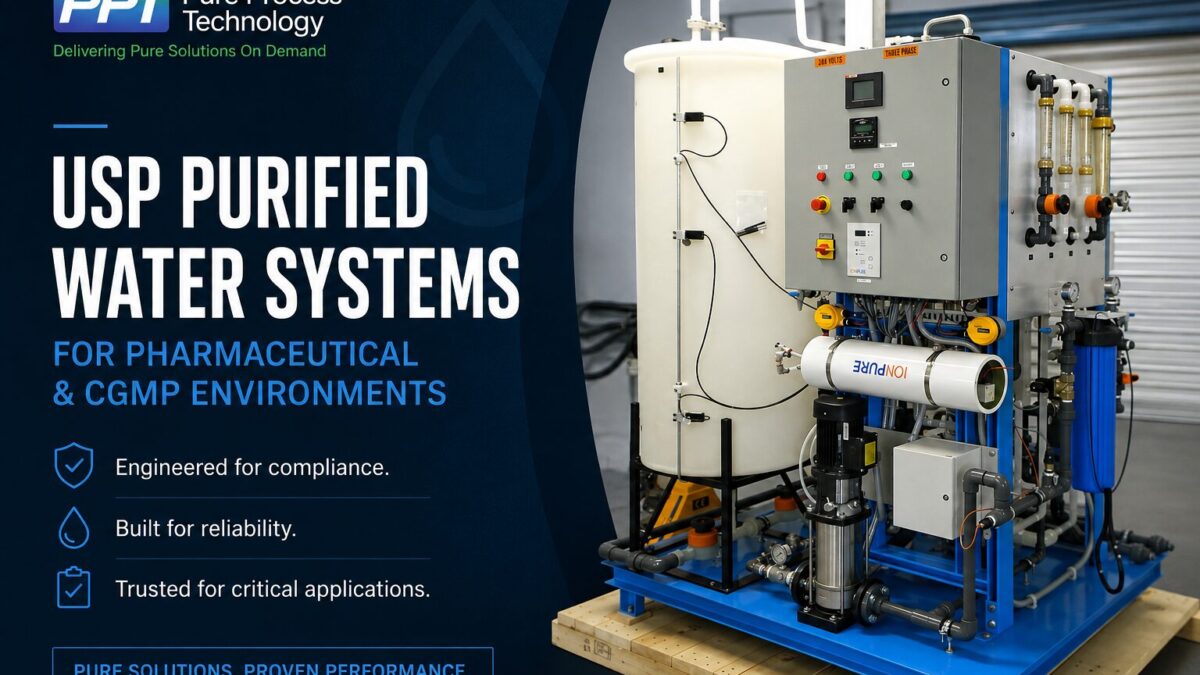
USPPharmaceutical and biotech facilities often need more from a water purification system than simply producing low-conductivity water.
The system may also need sanitary construction, controlled distribution, microbial management, monitoring, documentation, qualification support, and a design that fits the facility’s cGMP requirements.
That is where a USP purified water system differs from a general laboratory RO/DI system.
A well-planned pharmaceutical water system connects the required water quality to the treatment process, storage, distribution loop, materials, controls, sanitization strategy, documentation, and long-term maintenance plan.
Pure Process Technology’s SaniSpec USP purified water system is designed for sanitary and cGMP-aligned applications where facilities need dependable USP-quality water and a system designed around regulated operating requirements.
What Is USP Purified Water?
USP Purified Water is a pharmaceutical water grade used in drug manufacturing, laboratory, cleaning, formulation, and process applications.
A key distinction is that USP requirements define the quality of the finished water, rather than prescribing one specific purification technology.
A high-purity water purification system designed for a USP application may combine several treatment stages, including:
- Pretreatment
- Reverse osmosis
- Deionization
- Electrodeionization
- UV treatment
- Filtration
- Microbial control
- Storage
- Recirculating distribution
The right treatment train depends on feedwater quality, facility usage, required capacity, microbial control strategy, and the User Requirement Specification, or URS.
For teams still defining those requirements, PPT’s Water System Spec Review provides a way to review treatment, storage, distribution, documentation, and facility requirements before equipment is selected.
USP Purified Water Is Not the Same as ASTM Type I Water
One common source of confusion is treating USP Purified Water and laboratory water grades as interchangeable.
They are not.
ASTM Type I, Type II, and Type III classifications are commonly used for laboratory reagent water. USP Purified Water is a pharmaceutical water specification used in regulated applications.
A pharmaceutical facility might also need ASTM-grade water for analytical or research functions, but that does not automatically make a standard laboratory water system appropriate for the process water requirement.
For more on laboratory water classifications, read Type I vs. Type II vs. Type III Water: What Does Your Lab Actually Need?.
For a USP project, start with the process and regulatory requirements rather than selecting equipment around a generic purity label.
What Does cGMP Mean for a Purified Water System?
cGMP considerations go beyond the final conductivity reading.
A pharmaceutical water system needs to support repeatable production and control of the water throughout treatment, storage, and distribution.
That can affect decisions around:
- Materials of construction
- Hygienic piping
- Drainability
- Dead-leg control
- Recirculation
- Instrumentation
- Sanitization
- Alarm handling
- Data collection
- Documentation
- Maintenance procedures
- Qualification activities
The exact requirements depend on the application and the facility’s quality system.
That is why a cGMP purified water system should be planned as an integrated utility rather than a collection of individual purification components.
How Does a USP Purified Water System Work?
A typical system treats incoming water through several stages before it reaches the process or point of use.
The exact configuration varies by facility and application.
Pretreatment
Pretreatment protects downstream purification equipment.
Depending on the feedwater, this may address:
- Hardness
- Chlorine
- Chloramine
- Sediment
- Iron
- Manganese
- Organics
- Other contaminants
Feedwater chemistry affects RO membrane life, DI capacity, microbial control, operating cost, and system reliability.
Reverse Osmosis
Reverse osmosis is commonly used as a primary purification step.
RO membranes reduce dissolved salts, hardness, organics, particles, and many other contaminants before downstream polishing.
The RO stage also reduces the contaminant load placed on DI, EDI, UV, and other polishing components.
Deionization or EDI
Ion-removal technologies may be used after RO to further reduce ionic contamination.
The exact method depends on system capacity, water-quality requirements, maintenance strategy, and facility preferences.
PPT’s SaniSpec system can be configured around the facility’s URS, required water quality, and operating conditions.
UV and Final Filtration
UV treatment may be included for microbial management or organic control depending on the system design.
Sub-micron or final filtration may also be used at specific locations.
These stages should be selected around the intended water quality and microbial control strategy rather than added automatically to every system.
Storage and Distribution Matter Just as Much as Purification
Producing acceptable water at the purification skid does not guarantee acceptable water at the point of use.
After purification, water may travel through:
- Storage tanks
- Pumps
- Distribution piping
- Valves
- Instruments
- Sample ports
- Points of use
The storage and distribution system needs to preserve the required water quality.
This is one reason pharmaceutical water systems commonly use recirculating distribution rather than allowing purified water to remain stagnant in long piping branches.
A distribution design may need to account for:
- Loop velocity
- Flow and pressure
- Pipe material
- Hygienic fittings
- Drainability
- Dead legs
- Temperature
- Sanitization
- Sampling locations
- Return flow
- Future connections
Facilities deciding how water should be produced and distributed can also review Centralized vs. Point-of-Use Water Purification Systems for a broader look at system architecture.
Why Microbial Control Needs to Be Planned Early
Microbial control is one of the major differences between a simple laboratory purification system and a sanitary pharmaceutical water system.
Microorganisms can enter or grow within storage and distribution systems if operating conditions allow them to establish themselves.
A microbial control strategy may include:
- Continuous recirculation
- Sanitization
- UV
- Filtration
- Appropriate materials
- Hygienic system geometry
- Tank design
- Monitoring
- Routine sampling
- Preventative maintenance
Sanitization methods may include hot water or ozone depending on the facility, materials, and system design.
These requirements should be established early enough to influence equipment, piping, controls, and documentation.
Hot-Water vs. Ozone Sanitization
There is no single sanitization method that fits every pharmaceutical water system.
Hot-Water Sanitization
Hot-water sanitization uses elevated temperature to control microbial growth throughout compatible portions of the system.
The design needs to account for:
- Materials
- Thermal expansion
- Heat load
- Energy use
- Tank design
- Components
- Controls
Ozone Sanitization
Ozone provides another approach to microbial control.
Its use requires appropriate generation, monitoring, materials compatibility, destruction, and control strategies.
The selection between hot water, ozone, or another method should be made as part of the complete system design rather than added late in the project.
Monitoring a USP Purified Water System
A regulated water system needs enough instrumentation to show that it is operating within defined parameters.
Monitoring may include:
- Conductivity or resistivity
- Temperature
- TOC
- Flow
- Pressure
- Tank level
- Sanitization status
- System alarms
The exact instrumentation package should be driven by the URS and facility quality requirements rather than installing instruments simply for the sake of collecting more data.
What Is USP <645> Conductivity?
USP <645> addresses conductivity testing for pharmaceutical water.
Conductivity provides a way to assess ionic contamination.
A properly designed system may monitor conductivity or resistivity continuously and provide alarms if performance moves outside the defined operating range.
Conductivity is only one part of the water-quality program. It does not replace microbial monitoring, TOC requirements where applicable, or other facility-specific controls.
What About TOC?
Total Organic Carbon, or TOC, provides information about organic contamination in purified water.
Depending on the application and monitoring strategy, a pharmaceutical water system may include online or offline TOC measurement.
Online monitoring can provide greater visibility into changes in water quality and help facility teams identify developing issues.
Whether TOC instrumentation belongs on the system should be determined by the facility’s requirements and monitoring strategy.
Documentation and Qualification Support
Pharmaceutical water projects often involve more documentation than standard laboratory installations.
Project documentation may include:
- User Requirement Specification
- Equipment specifications
- Material documentation
- Instrument information
- Drawings
- Control narratives
- Factory testing records
- Installation documentation
- Operating procedures
- Maintenance procedures
- IQ/OQ support
These requirements should be identified before fabrication whenever possible.
PPT can support FAT/SAT and qualification-related requirements on appropriate sanitary projects. For more detail, read Are There Suppliers Offering Hygienic Skids with FAT/SAT Validation Support?.
What Are FAT and SAT?
A Factory Acceptance Test, or FAT, is performed before the system leaves the manufacturer’s facility.
It may verify:
- System assembly
- Controls
- Instrumentation
- Alarm functions
- Pumps
- Valves
- Operating sequences
- Documentation
A Site Acceptance Test, or SAT, occurs after installation and helps verify that the installed system operates properly in its final environment.
FAT and SAT requirements should be defined early so the supplier and facility agree on what will be tested, documented, and accepted.
What Are IQ and OQ?
Installation Qualification and Operational Qualification are common parts of equipment qualification.
IQ generally verifies that the system was installed according to approved requirements and documentation.
OQ generally verifies that the equipment operates as intended across defined operating conditions.
The facility’s validation and quality teams define the required qualification approach. The water-system supplier can support that process through documentation, testing, and technical information.
When Does SaniSpec Make Sense?
PPT’s SaniSpec USP purified water system is intended for sanitary applications where USP-quality water, controlled distribution, monitoring, sanitization, and qualification support need to be considered together.
Potential applications include:
- Pharmaceutical R&D
- Biotech laboratories
- QA/QC laboratories
- Pilot facilities
- Controlled production areas
- Process development
- Regulated laboratory environments
The advantage of starting with a configurable sanitary platform is that the project does not necessarily need to begin as a completely custom system.
For projects with unusual capacity, controls, distribution, integration, or process requirements, PPT also develops custom-engineered water purification systems.
Standard Platform or Custom Pharmaceutical Water System?
Not every USP water project needs a fully custom system.
A configurable platform can reduce engineering work and provide a known starting architecture.
A custom-engineered system may make more sense when the project involves:
- Higher flow rates
- Large storage volumes
- Complex distribution
- Unusual feedwater
- Multiple treatment trains
- Specialized controls
- Redundancy requirements
- Site-specific sanitization
- Unique materials
- Existing utility integration
- Nonstandard documentation requirements
The system architecture should follow the URS rather than forcing the application into a standard equipment package.
If the correct path is not obvious, request a Water System Spec Review before finalizing the specification.
How Much Capacity Does a Pharmaceutical Water System Need?
Flow rate should not be selected from a catalog number alone.
The system needs to account for:
- Average daily demand
- Peak demand
- Batch requirements
- Number of points of use
- Simultaneous use
- Storage
- Loop demand
- Production schedule
- Sanitization cycles
- Future expansion
A system that produces enough gallons over 24 hours may still be undersized for a short high-demand production period.
Storage can help bridge that gap.
For a detailed approach to calculating production, peak demand, and storage, read How to Size a Lab Water Purification System.
Feedwater Conditions Affect the Entire System
The quality of incoming water affects nearly every downstream treatment stage.
Document feedwater conditions such as:
- Hardness
- Conductivity
- Chlorine
- Chloramine
- Silica
- Iron
- Manganese
- pH
- Temperature
- Pressure
- Seasonal variation
These values affect pretreatment, membrane performance, DI life, operating cost, and maintenance.
A pharmaceutical water system designed from assumptions rather than actual feedwater data can create avoidable problems after startup.
Maintenance Is Part of the System Strategy
A sanitary system still needs routine service.
Maintenance may include:
- Pretreatment replacement
- RO membrane monitoring
- DI or EDI maintenance
- UV lamp replacement
- Filter changes
- Instrument calibration
- Sanitization
- Pump inspection
- Valve inspection
- Alarm testing
- Water-quality verification
- Documentation
PPT provides water purification system service and support for preventative maintenance, troubleshooting, system assessments, repairs, and ongoing service requirements.
For regulated facilities, maintenance procedures and records should align with the site’s quality and operating requirements.
Common USP Water System Planning Mistakes
Starting With Equipment Instead of the URS
Do not select the skid first and define requirements later.
Start with water quality, demand, distribution, documentation, controls, sanitization, and operating needs.
Focusing Only on Conductivity
Conductivity matters, but a USP purified water system is more than a conductivity number.
Storage, distribution, microbial control, TOC, monitoring, and maintenance can all affect system performance.
Ignoring the Distribution Loop
Water quality needs to be maintained all the way to the point of use.
A poorly planned distribution system can undermine good purification equipment.
Leaving Qualification Requirements Until the End
IQ/OQ, FAT/SAT, turnover documents, control requirements, and data needs should be defined early.
Adding documentation requirements after fabrication can create delays and rework.
Underestimating Peak Demand
Average gallons per day can hide short periods of high demand.
Production rate, storage, distribution, and simultaneous use need to be reviewed together.
Forgetting Long-Term Service
Sanitary systems need access for maintenance, calibration, sanitization, inspection, and component replacement.
Serviceability should be designed into the system.
USP Purified Water System Planning Checklist
Before selecting or specifying a pharmaceutical water system, document:
- Required water quality
- Intended applications
- Applicable facility standards
- Feedwater analysis
- Daily demand
- Peak demand
- Required flow rate
- Storage capacity
- Distribution layout
- Points of use
- Materials requirements
- Sanitization strategy
- Microbial control requirements
- Conductivity monitoring
- TOC monitoring
- BMS/SCADA requirements
- Alarm requirements
- Redundancy
- FAT requirements
- SAT requirements
- IQ/OQ requirements
- Turnover documentation
- Maintenance access
- Future capacity
PPT’s Lab Water System Specification Checklist for Engineers provides a broader planning framework for documenting many of these requirements before equipment is specified.
USP Purified Water System FAQs
What is a USP purified water system?
A USP purified water system is designed to produce water that meets applicable USP Purified Water requirements for pharmaceutical or other regulated applications. Treatment may include RO, DI or EDI, microbial control, storage, distribution, and monitoring.
Does USP require reverse osmosis?
USP defines water-quality requirements rather than prescribing one universal purification train. RO is commonly used in pharmaceutical purified water systems, but the treatment process should be selected around feedwater conditions and the required finished-water quality.
Is USP Purified Water the same as DI water?
No. DI describes a treatment method used to remove ions. USP Purified Water describes a water quality. Deionization may be one stage of a system designed to produce USP Purified Water.
Does a USP water system need a recirculating loop?
Many pharmaceutical systems use recirculation to help maintain water quality and manage microbial risk throughout distribution. The distribution design should follow the facility’s URS, operating requirements, and microbial control strategy.
Does a pharmaceutical water system need TOC monitoring?
TOC requirements depend on the application and facility monitoring strategy. A system can incorporate TOC monitoring when required.
Can a USP water system also provide laboratory-grade water?
Potentially. A facility can use different treatment stages or point-of-use polishing to provide different water qualities from a broader purification architecture. The individual applications should be reviewed before combining them onto one system.
Planning a USP or cGMP Purified Water System?
A pharmaceutical water system should not be selected from purity level alone.
Feedwater, flow, storage, distribution, materials, microbial control, sanitization, instrumentation, documentation, qualification, maintenance, and future capacity all affect the final design.
PPT’s SaniSpec USP purified water system provides a configurable sanitary platform for pharmaceutical, biotech, QA/QC, R&D, and other regulated environments. Projects requiring different capacities or system architectures can be addressed through PPT’s custom-engineered water purification solutions.
If your team is planning, replacing, or specifying a pharmaceutical water system, request a Water System Spec Review.
Send PPT your URS, water-quality requirements, usage data, distribution plans, or current specification. The team can review the project requirements and help identify the appropriate system path before purchasing or installation.