
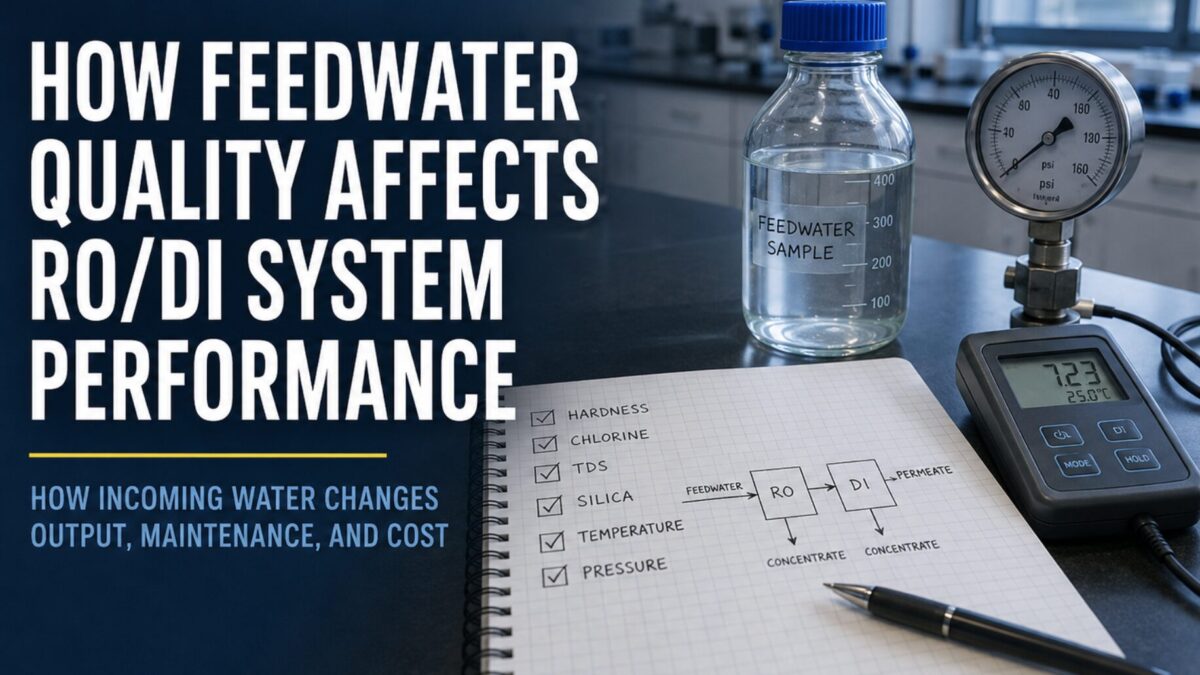
How Feedwater Quality Affects RO/DI System Performance
Two facilities can install similar RO/DI water purification systems and experience very different results.
One system may deliver stable water quality, predictable output, and long consumable life. The other may struggle with low production, frequent filter changes, premature membrane failure, high DI resin usage, or inconsistent purity.
The difference often starts with the water entering the system.
Feedwater quality directly affects pretreatment requirements, reverse osmosis performance, DI resin life, system capacity, maintenance frequency, and the long-term cost of producing purified water. Testing that water before selecting an RO/DI water purification system helps the system get designed around real facility conditions instead of ideal catalog ratings.
What Is Feedwater?
Feedwater is the incoming water supplied to a purification system before treatment. It may come from a municipal supply, private well, building treatment system, or another process-water source.
Feedwater quality cannot be represented by one number. A useful analysis may include:
- Conductivity or total dissolved solids
- Hardness
- Chlorine and chloramine
- Silica
- Iron and manganese
- Suspended solids and turbidity
- pH and alkalinity
- Dissolved carbon dioxide
- Organic content
- Microbial load
- Water temperature
- Inlet pressure
- Seasonal variation
Each factor affects the purification process differently. Some conditions place more load on the RO membrane. Others increase DI resin use or create scaling, fouling, microbial, and maintenance concerns.
Why Published RO Production Ratings Can Be Misleading
RO system production ratings are measured under defined inlet conditions. Actual production can change when a facility’s feedwater temperature, pressure, or dissolved-solids level differs from those conditions.
A system rated for a specific number of gallons per day may produce less when supplied with cold water or low pressure. Membrane output and rejection can also decline when the membrane becomes scaled, fouled, chemically damaged, or improperly protected.
This does not always indicate an equipment problem. It can signal that the system was not selected or configured for the conditions at the site.
Before relying on a published production number, confirm:
- The feedwater temperature used for the rating
- The required inlet pressure
- The assumed feedwater conductivity or TDS
- The expected membrane recovery rate
- Whether the stated output assumes specific pretreatment
- How production changes under the facility’s worst expected conditions
Feedwater is one of several factors covered in PPT’s guide on how to size a lab water purification system.
How Hardness Affects RO Membranes
Hardness is commonly associated with calcium and magnesium in the feedwater.
As an RO system separates purified permeate from reject water, minerals become more concentrated on the feed side of the membrane. Under the wrong conditions, these minerals can form scale on the membrane surface.
RO membrane scaling can:
- Reduce purified-water production
- Increase pressure requirements
- Lower recovery
- Increase reject-water volume
- Create more frequent cleaning requirements
- Shorten membrane life
Pretreatment may include water softening, antiscalant dosing, filtration, or an adjusted recovery rate. The right approach depends on the complete water analysis, system size, operating schedule, and maintenance plan.
Hardness should not be evaluated alone. Alkalinity, pH, silica, and other constituents can also change the system’s scaling risk.
Chlorine and Chloramine Can Damage RO Membranes
Municipal water systems commonly use free chlorine or chloramine to control microorganisms. These disinfectants do not behave identically and may require different pretreatment strategies.
Many RO membranes have limits for oxidant exposure. Inadequate chlorine or chloramine removal can damage a membrane and reduce its ability to reject dissolved contaminants.
The system may continue producing water, but more contaminants can pass into the RO permeate. That creates a heavier load on downstream DI resin and polishing equipment.
Carbon filtration is commonly used to reduce disinfectants before the RO membrane. Carbon capacity, flow rate, contact time, disinfectant type, and replacement frequency all affect performance.
Chloramine may require more contact time or a different carbon strategy than free chlorine. Assuming a standard carbon filter will handle every municipal supply can leave the membrane insufficiently protected.
Facilities should identify which disinfectant is present and ask the water supplier about temporary treatment changes. Some utilities periodically switch disinfection methods, which can change pretreatment requirements.
Conductivity, TDS, and DI Resin Life
Feedwater conductivity provides a useful indication of dissolved ionic content.
Reverse osmosis removes a large portion of these dissolved contaminants before water reaches the DI stage. When RO rejection declines or incoming conductivity rises, the DI resin receives a heavier ionic load.
This can create a costly sequence:
- RO rejection declines.
- More dissolved ions reach the DI stage.
- DI tanks or cartridges become exhausted faster.
- Consumable and service costs rise.
- Final water quality becomes harder to maintain.
A system may still produce acceptable final resistivity for a period of time, masking declining RO performance behind frequent DI replacements.
Monitoring feedwater conductivity, RO permeate conductivity, and final product-water quality makes it easier to determine whether a change is coming from the facility supply, RO membrane, or downstream polishing stage.
PPT’s guide to Type I, Type II, and Type III lab water explains how different purification stages can support different water-quality requirements.
Carbon Dioxide Can Increase DI Consumption
Dissolved carbon dioxide can pass through an RO membrane and form ionic species downstream. Those ions must then be removed by the DI resin.
A facility may see acceptable RO conductivity but still experience unusually short DI resin life when dissolved carbon dioxide is present. Conductivity measurements alone may not explain the increased resin consumption.
Depending on the water chemistry and system size, degasification may be used to reduce this load before final DI polishing.
The financial value of this added treatment depends on:
- Purified-water volume
- Existing DI replacement frequency
- Required final purity
- Resin and service costs
- Available system space
- Expected system life
Reviewing lifecycle costs can show whether additional pretreatment will reduce the total cost of operating the system.
Silica Can Create Purity and Scaling Problems
Silica requires special attention in high-purity water applications.
High silica levels can contribute to RO membrane scaling. Silica may also be difficult to identify using conductivity alone, and some applications have specific silica limits.
A system can meet a general conductivity or resistivity target without meeting every application-specific requirement.
Feedwater testing should include silica when it matters to the process. The results can affect pretreatment, membrane selection, recovery rate, polishing technology, and monitoring.
If the required final water quality is unclear, PPT’s water purity standards guide provides a starting point for comparing common purity classifications and project requirements.
Iron, Manganese, and Suspended Solids
Iron, manganese, sediment, and other suspended material can foul filters, carbon beds, softeners, and RO membranes.
These contaminants may:
- Increase pressure drop
- Reduce water flow
- Load filters prematurely
- Create deposits on membranes
- Increase maintenance frequency
- Support microbial growth
- Reduce treatment efficiency
Well water often requires close analysis, but municipal water can also carry sediment from corrosion, distribution work, flushing, or temporary disturbances.
Pretreatment may include sediment filtration, multimedia filtration, or application-specific iron and manganese removal. Pressure gauges and monitoring can help staff identify filter loading before it restricts flow to downstream equipment.
Cold Feedwater Reduces RO Production
RO membrane production changes with feedwater temperature. Cold water passes through an RO membrane more slowly than warm water, reducing purified-water output.
This is particularly relevant for facilities in New England and other areas with large seasonal temperature changes.
A system sized using a summer feedwater measurement may produce materially less during winter. If the system has no extra production or storage capacity, the facility may experience slow recovery, low tank levels, or water shortages during peak demand.
A properly sized system should account for realistic winter feedwater temperatures rather than relying only on an annual average.
Storage can support short periods of heavy use, but it cannot correct a purification system that lacks enough production capacity to recover throughout the operating day.
Low or Unstable Inlet Pressure Affects Output
RO requires sufficient pressure to move water through the membrane. Low or unstable building pressure can reduce production and cause inconsistent system performance.
Water pressure may also change throughout the day as other equipment and building users draw from the same supply.
A static pressure reading taken when the building is quiet may not represent conditions during peak operations. Site planning should document:
- Static and dynamic inlet pressure
- Available feedwater flow
- Supply-pipe size
- Pressure changes during peak use
- Other equipment connected to the supply
- Expected simultaneous demand
A booster pump, break tank, pressure controls, or changes to the feedwater connection may be needed to provide stable operating conditions.
Feedwater Can Change Throughout the Year
Incoming water quality is not always constant.
Municipal sources, treatment methods, disinfectants, temperature, conductivity, hardness, and turbidity can change during the year. Construction, hydrant flushing, seasonal runoff, and source changes can also affect the water entering a facility.
A single sample provides useful information, but it may not represent the most demanding condition the system will face.
Ask the facility or water supplier about:
- Seasonal water-source changes
- Changes between chloramine and free chlorine
- Published water-quality reports
- Reported hardness ranges
- Winter inlet temperatures
- Past sediment problems
- Pressure fluctuations
- Planned treatment changes
Critical water systems should be designed around the expected operating range, not just one ideal sample.
How Feedwater Quality Affects Operating Cost
Feedwater quality affects the cost of producing every gallon of purified water.
Feedwater conditions that are not properly addressed can increase:
- Sediment-filter replacement
- Carbon replacement
- Softener salt or chemical use
- RO membrane cleaning
- RO membrane replacement
- DI tank exchanges
- DI cartridge replacement
- Reject-water volume
- Service visits
- Energy usage
- Sanitization requirements
- Unplanned downtime
A less expensive system with minimal pretreatment can cost more over its service life than a properly configured system with a higher initial price.
The more useful comparison is not equipment price alone. It is the long-term cost of reliably producing the required water quality under actual facility conditions.
What Should Be Tested Before Selecting an RO/DI System?
The testing scope should match the water source and application. A practical starting point may include:
| Feedwater factor | What it can affect |
|---|---|
| Conductivity or TDS | RO loading, rejection, and DI consumption |
| Hardness | Scaling risk and membrane recovery |
| Chlorine and chloramine | Carbon pretreatment and membrane protection |
| Silica | Scaling, polishing, and application limits |
| Iron and manganese | Fouling and pretreatment |
| Turbidity and suspended solids | Filter loading and membrane fouling |
| pH and alkalinity | Scaling chemistry and treatment selection |
| Carbon dioxide | DI resin life |
| Temperature | RO production rate |
| Inlet pressure and flow | System output and stability |
| Microbial conditions | Sanitization and microbial-control planning |
These results should be reviewed alongside the required product-water quality, daily volume, peak demand, storage, distribution, redundancy, maintenance plan, and available space.
PPT’s Lab Water System Specification Checklist for Engineers provides a broader list of information to collect before selecting equipment.
Design the System Around the Water It Will Receive
Feedwater testing is a relatively small planning step that can prevent major performance and operating-cost problems.
The right treatment path may include sediment filtration, carbon, softening, antiscalant, reverse osmosis, deionization, UV, ultrafiltration, final filtration, or another application-specific process. The answer depends on what is in the incoming water and what the purified water must accomplish.
PPT reviews feedwater, required purity, daily demand, peak use, pretreatment, production, storage, distribution, monitoring, and service access as one connected system. Projects that fall outside a standard configuration can also be addressed through custom-engineered water purification solutions.
If you are planning a new RO/DI system, replacing an existing unit, or using filters and DI resin faster than expected, request a Water System Spec Review.