
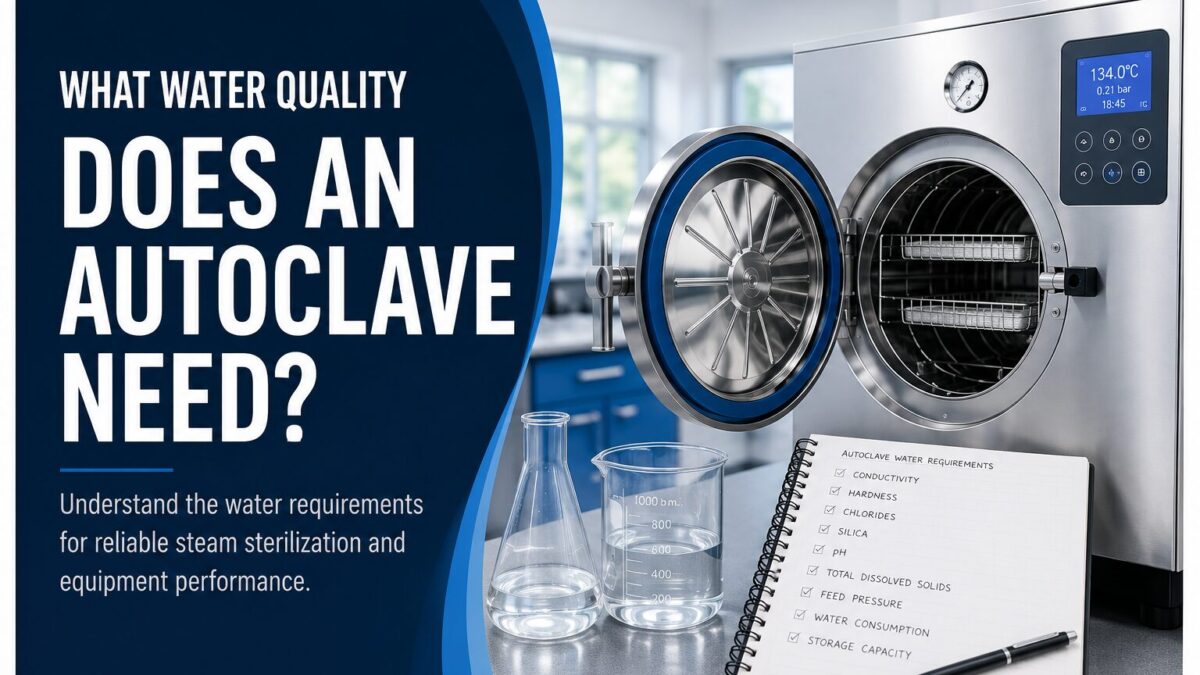
Autoclaves depend on water to generate the steam used during sterilization. That makes feedwater quality more than a utility detail.
Poor water quality can contribute to mineral buildup, scale, staining, corrosion, clogged components, reduced heat transfer, and added maintenance. Water that is perfectly acceptable for drinking may still contain hardness, chlorides, dissolved minerals, metals, or other contaminants that an autoclave manufacturer does not want entering the equipment.
So, what water quality does an autoclave actually need?
The answer depends on the autoclave.
Some applications may be properly served by reverse osmosis (RO) water. Others may require deionized (DI), RO/DI, distilled, or another specified quality. The correct starting point is always the water specification provided by the autoclave manufacturer, followed by a review of how much water the equipment uses and how that water will be supplied.
Can You Use Tap Water in an Autoclave?
In many installations, untreated tap water is not a good long-term feedwater source for steam generation.
Municipal water commonly contains dissolved minerals such as calcium and magnesium. When water is repeatedly heated and converted to steam, these minerals can remain behind and form deposits.
Scale can accumulate in:
- Steam generators
- Heating elements
- Piping
- Valves
- Level sensors
- Chambers
- Other wetted components
Over time, deposits can restrict flow and reduce heat transfer. Chlorides and other contaminants can also contribute to corrosion or staining under certain operating conditions. Autoclave manufacturer Tuttnauer specifically cautions against using untreated tap water for steam generation when it does not meet the equipment’s water-quality requirements.
The goal is not simply to provide “clean water.” The goal is to supply water that falls within the specifications of the sterilizer.
Does an Autoclave Need RO or DI Water?
This is where the answer becomes application-specific.
Reverse Osmosis Water
Reverse osmosis removes a large percentage of dissolved ions, minerals, and other contaminants from incoming water.
RO can substantially reduce:
- Hardness
- Dissolved salts
- Calcium
- Magnesium
- Chlorides
- Many metals
- Total dissolved solids
For many autoclave applications, properly treated RO water can provide a significant improvement over untreated municipal water.
RO systems are also practical when the facility needs purified water for several applications beyond the autoclave.
An autoclave, glassware washer, rinse station, and general laboratory use may all be supported from a properly designed high-purity water purification system.
Deionized Water
Deionization removes charged ions from water and can produce substantially higher ionic purity.
An autoclave manufacturer may call for DI water, RO/DI water, distilled water, or another defined specification depending on equipment construction and operating conditions.
DI water should not be selected simply on the assumption that “purer is always better.” Water chemistry and materials compatibility still matter.
The manufacturer’s specifications should identify acceptable conductivity, hardness, chloride concentration, pH, or other water-quality limits.
If your team is also trying to understand laboratory water classifications, see Type I vs. Type II vs. Type III Water: What Does Your Lab Actually Need?.
Why Does Autoclave Water Quality Matter?
Water quality can affect both the sterilizer and the loads being processed.
Scale and Mineral Deposits
Hardness minerals left behind during steam generation can accumulate on heated surfaces.
As deposits build, they can interfere with:
- Heat transfer
- Heating elements
- Water-level sensors
- Valves
- Steam generators
- Piping
The equipment may then require more frequent cleaning or service.
Corrosion
Chlorides and certain other dissolved contaminants can contribute to pitting or corrosion of stainless-steel components under the wrong conditions.
This is one reason water requirements should be taken directly from the sterilizer manufacturer rather than assuming that any purified water is suitable.
Staining and Residue
Impurities carried with steam can leave deposits or discoloration on chamber surfaces, glassware, instruments, or other sterilized materials.
This can become particularly frustrating in research and healthcare environments where cleanliness and repeatability matter.
Maintenance and Equipment Life
Poor feedwater can create recurring maintenance problems that could have been reduced through proper pretreatment.
Water treatment does not replace autoclave maintenance, but supplying the equipment with water that meets its specification can reduce avoidable stress on the system.
If an existing water system is no longer maintaining its intended quality or output, see Signs Your Water Purification System Needs Maintenance or an Upgrade.
Start With the Autoclave Manufacturer’s Water Specification
Before selecting a purification system, obtain the technical requirements for the autoclave.
Look for specifications covering:
- Conductivity
- Total dissolved solids
- Hardness
- Chlorides
- Silica
- pH
- Iron or other metals
- Microbial limits
- Feed pressure
- Required flow
- Water consumption per cycle
Do not specify the water system from the phrase “DI water required” alone.
The complete specification gives the water-system designer a much better target.
Two autoclaves can have very different requirements. A small benchtop sterilizer operating a few times each day creates a different water demand than several large steam sterilizers running continuously.
How Much Purified Water Does an Autoclave Need?
Purity is only half of the planning problem.
The purification system also has to produce enough water to support real autoclave usage.
Document:
- Water consumption per cycle
- Cycles per day
- Number of autoclaves
- Whether multiple units operate at the same time
- Peak operating periods
- Required feed pressure
- Available refill time
- Other equipment sharing the purified-water source
For example, a facility operating one autoclave periodically may have a modest daily demand.
A research facility running several autoclaves, glassware washers, and laboratory outlets from the same purified-water source could require much more production capacity and storage.
That is why system sizing should consider both total daily demand and short periods of peak consumption.
For a complete sizing process, see How to Size a Lab Water Purification System.
Does an Autoclave Need Its Own Water Purification System?
Not necessarily.
There are three common ways to approach autoclave water.
1. Dedicated Purification System
A smaller autoclave or isolated sterilization area may be served by its own water purification system.
This can make sense when:
- Water demand is relatively low
- The autoclave is far from other purified-water users
- No central purified-water distribution system exists
- The application has its own defined water specification
For lower-demand applications, PPT’s MiniLab water purification system may provide a compact starting point when its capacity and treatment configuration match the sterilizer requirements.
The final system still needs to be selected against the actual autoclave specifications and usage.
2. Shared Laboratory Water System
A lab may already need purified water for several applications.
The same system may support:
- Autoclaves
- Glassware washers
- Laboratory dispensing
- Rinse applications
- Media preparation
- Equipment feedwater
For mid-volume applications, PPT’s QuickLab system provides a turnkey platform designed for laboratory water production.
A shared system can reduce the need for separate treatment equipment at every device, provided the required water quality, pressure, production rate, and storage capacity line up with each application.
3. Centralized Facility Water System
Larger facilities may supply several autoclaves and other users from a centralized purification system.
This may involve:
- Pretreatment
- Reverse osmosis
- DI or EDI polishing
- Storage
- Distribution pumps
- Recirculating piping
- Monitoring and controls
- Multiple equipment connections
PPT’s SkidSpec high-purity water system is designed for higher-capacity applications, facility water infrastructure, distribution loops, and custom system requirements.
PPT lists sterilization and washing among SkidSpec applications, making it a more logical starting point when autoclave water is part of a larger facility water demand rather than a single piece of equipment.
Point-of-Use vs. Central Water for Autoclaves
A dedicated system is not automatically better than a centralized one.
The decision often comes down to:
- Number of autoclaves
- Distance between equipment
- Other purified-water applications
- Total daily demand
- Peak demand
- Available mechanical space
- Distribution piping
- Maintenance strategy
- Future expansion
A single autoclave in an existing laboratory may favor a local solution.
Several autoclaves in a new research or healthcare facility may make a central system much more practical.
A hybrid system can also work. A facility may centrally produce RO water, then apply further treatment only where a higher water quality is required.
For a deeper comparison, see Centralized vs. Point-of-Use Water Purification Systems.
What If the Autoclave Requires a Different Water Quality Than the Rest of the Lab?
This is common.
A laboratory may have several different water requirements at the same time.
For example:
- An autoclave may require RO-quality feedwater.
- General laboratory work may require Type II water.
- Sensitive analytical equipment may require Type I water.
- A glassware washer may have its own feedwater and final-rinse specifications.
The entire facility does not necessarily need to produce and distribute the highest purity required by any single application.
A properly designed water system can divide treatment into stages and deliver the appropriate quality where it is needed.
This approach can simplify system design and reduce unnecessary treatment.
Do You Need Storage for Autoclave Water?
Storage can be very useful when an autoclave creates short periods of high water demand.
A purification system might produce enough water over the course of a day but not fast enough to supply several cycles occurring close together.
A storage tank allows purified water to accumulate between periods of use.
When evaluating storage, review:
- Peak water demand
- Production rate
- Tank capacity
- Refill time
- Number of sterilizers
- Simultaneous operation
- Other equipment connected to the system
Storage should also be designed with water quality in mind. Tank materials, venting, turnover, sanitization, and distribution can all affect stored purified water.
Don’t Forget Feedwater Conditions
The performance of the purification system starts with the water entering it.
Incoming water can vary significantly between facilities.
Useful feedwater information includes:
- Conductivity or TDS
- Hardness
- Chlorine or chloramine
- Silica
- Iron
- Manganese
- pH
- Temperature
- Pressure
These conditions can affect pretreatment requirements, membrane performance, DI capacity, operating cost, and maintenance.
For a new facility or major equipment installation, reviewing feedwater early can prevent problems later in the project.
Planning Autoclave Water for a New Lab or Facility
Autoclave feedwater should be planned alongside the rest of the laboratory utilities.
Engineers and facility teams should confirm:
- Autoclave manufacturer and model
- Number of sterilizers
- Manufacturer water specification
- Consumption per cycle
- Expected cycles per day
- Peak simultaneous use
- Incoming water quality
- Available utility pressure
- Required purified-water pressure
- Storage requirements
- Distribution distance
- Other purified-water users
- Available mechanical space
- Maintenance access
- Future expansion
These details allow the purification system to be sized around what the autoclaves actually require instead of selecting equipment from a generic gallon-per-day rating.
Engineers planning a larger lab project can also use PPT’s Lab Water System Specification Checklist for Engineers to organize water-quality, capacity, storage, distribution, and facility requirements before equipment is selected.
Common Autoclave Water Planning Mistakes
Assuming All Autoclaves Need the Same Water
Requirements differ between manufacturers, models, steam-generation methods, and materials of construction.
Always verify the specific equipment requirements.
Selecting Water Treatment Based Only on Purity
A system that produces the correct water quality can still fail the application if it cannot provide enough flow, storage, or recovery capacity.
Connecting New Equipment Without Rechecking System Capacity
Adding another autoclave to an existing water system can change peak demand significantly.
The purification system and storage tank should be reviewed before connecting new equipment.
Ignoring Feedwater Quality
RO production and pretreatment needs depend partly on incoming water conditions.
A system selected without reviewing feedwater can behave differently at the facility than expected from a standard equipment specification.
Treating Autoclave Water as an Isolated Utility
If a facility also needs water for washers, analyzers, rinsing, laboratory use, or other equipment, it may make more sense to plan the complete purified-water demand together.
Autoclave Water Quality FAQs
Can I use tap water in an autoclave?
Do not assume that potable tap water meets the sterilizer’s feedwater requirements. Hardness, chlorides, minerals, metals, and other contaminants can create deposits or equipment problems. Check the manufacturer’s specification for the specific autoclave.
Is RO water good for autoclaves?
RO water can be suitable for many autoclave applications when it meets the manufacturer’s specified limits. The acceptable treatment method can depend on boiler construction, water chemistry, and the sterilizer design.
Do autoclaves need DI water?
Some autoclaves or steam generators may call for DI, RO/DI, distilled, or another defined water quality. Others may operate properly on RO water. Follow the requirements for the specific equipment rather than assuming DI is required for every autoclave.
What happens if autoclave water is too hard?
Hard water can leave calcium, magnesium, and other mineral deposits when water is heated. These deposits can form scale on heating surfaces, piping, valves, sensors, and steam-generation components.
Can one water system supply several autoclaves?
Yes, if the system is designed for the required water quality, daily consumption, peak demand, pressure, storage, and distribution. Larger multi-autoclave facilities may benefit from a centralized system rather than individual treatment equipment.
Can the same purified-water system serve an autoclave and other lab equipment?
Potentially. The system needs to satisfy the water-quality and hydraulic requirements of every connected application. Different treatment stages or point-of-use polishing may be used when applications require different purity levels.
Choosing the Right Water System for an Autoclave
Start with the autoclave manufacturer’s requirements, then work backward to the purification system.
A smaller, low-demand application may be suited to a compact system such as MiniLab. A laboratory with moderate shared demand may fit a QuickLab configuration. Facilities supplying multiple sterilizers, washers, laboratories, or distribution points may require a larger SkidSpec or custom-engineered water system.
Pure Process Technology designs water purification systems around the required water quality, demand, feedwater, storage, distribution, controls, facility layout, and application.
If you are planning an autoclave installation, replacing an existing purification system, or trying to determine whether your current water source can support new equipment, request a Water System Spec Review.
PPT can review the equipment requirements and help determine the right purification approach before the system is purchased or installed.