
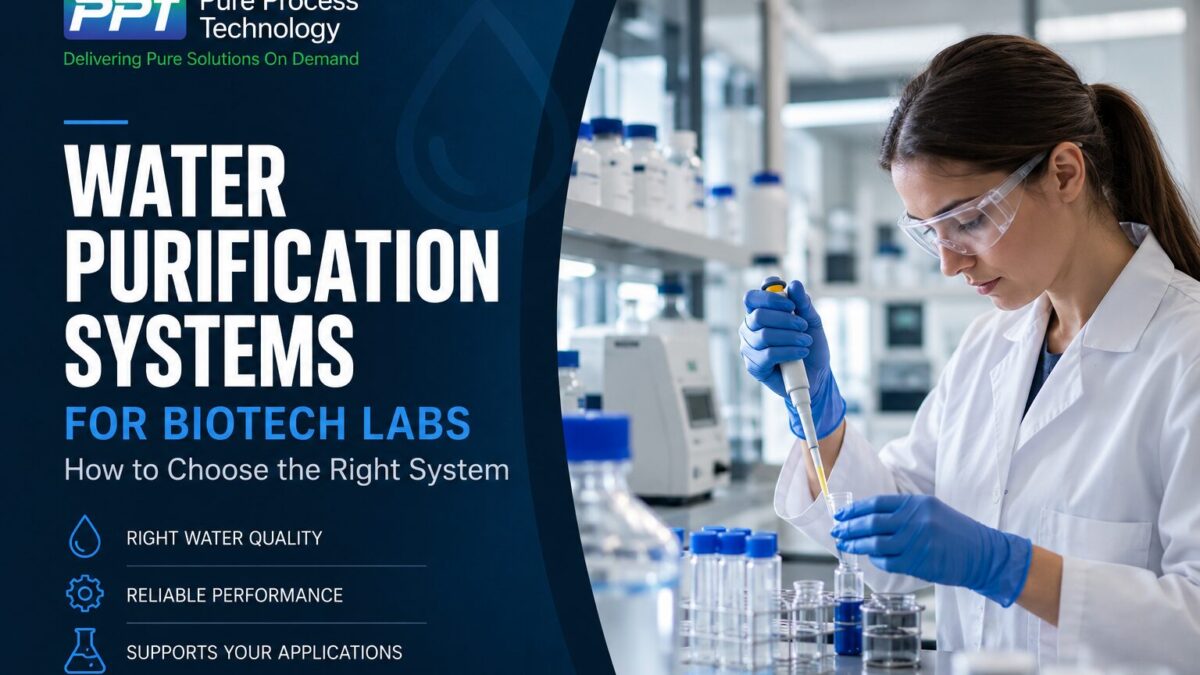
Biotech laboratories can place very different demands on purified water.
One lab may need Type II water for routine reagent preparation and washing. Another may need Type I water for sensitive analytical work. A biopharmaceutical or regulated facility may also need USP Purified Water, sanitary distribution, microbial control, monitoring, or qualification support.
That makes system selection less about choosing a single water grade and more about matching treatment, capacity, storage, distribution, and controls to the applications inside the facility.
Pure Process Technology designs high-purity water purification systems for research laboratories, biotech facilities, pharmaceutical environments, process applications, and larger facility water networks.
What Water Quality Does a Biotech Lab Need?
There is no single biotech water specification.
The required quality depends on how the water is used.
Common biotech applications include:
- Buffer and media preparation
- Reagent preparation
- Cell culture support
- Glassware rinsing
- Autoclave feed
- Washer feed
- Analytical instruments
- Molecular biology workflows
- General laboratory dispensing
- Process development
- QA/QC testing
- Pilot-scale production
Some of these applications may work well with RO or ASTM Type III water. Others may require ASTM Type II or Type I water.
Regulated or biopharmaceutical applications may have a separate USP Purified Water requirement.
For a detailed comparison of common laboratory water grades, see Type I vs. Type II vs. Type III Water: What Does Your Lab Actually Need?
RO, DI, and RO/DI Water in Biotech Labs
Most biotech water systems use more than one treatment stage.
Reverse Osmosis
Reverse osmosis removes a large percentage of dissolved salts, hardness, organics, particles, and other contaminants from incoming water.
RO is commonly used as the primary purification stage before higher-purity treatment.
It can also provide suitable water for applications that do not require very low ionic contamination.
Deionization
Deionization removes charged ions from the water.
Used after RO, DI can produce substantially lower conductivity and higher ionic purity.
RO/DI
RO/DI combines the strengths of both processes.
RO reduces the contaminant load first, then DI provides additional ionic polishing.
This configuration is common in biotech labs that need Type II water, ultrapure polishing, or feedwater for sensitive analytical applications.
Does a Biotech Lab Need Type I Water?
Not for every application.
Type I water is used for work where very low levels of ionic, organic, particulate, or microbial contamination matter.
Examples may include:
- HPLC
- LC-MS
- PCR
- Molecular biology
- Trace analysis
- Sensitive reagent preparation
Using Type I water for every sink, washer, or utility application can add unnecessary cost and consumable use.
A more practical setup may provide RO or Type II water to the broader laboratory and use point-of-use polishing only where Type I water is required.
Does a Biotech Facility Need USP Purified Water?
Some do.
Biotech R&D laboratories may only need ASTM laboratory water.
Biopharmaceutical, regulated, pilot-production, QA/QC, or process environments may have USP or cGMP-related requirements.
Those projects can require more attention to:
- Sanitary construction
- Recirculating distribution
- Microbial control
- Sanitization
- Conductivity monitoring
- TOC monitoring
- Documentation
- FAT/SAT
- IQ/OQ support
- BMS or SCADA integration
For those applications, read USP Purified Water Systems for Pharmaceutical and cGMP Environments.
PPT’s SaniSpec USP purified water system is designed for sanitary and regulated applications where water quality, distribution, monitoring, and qualification support need to be addressed together.
Point-of-Use or Centralized Water Purification?
Biotech facilities can use local systems, centralized systems, or a combination of both.
Point-of-Use Systems
A point-of-use system may make sense when:
- Only one lab needs purified water
- Demand is relatively low
- Use points are close together
- The building has no existing purified-water loop
- One application needs a higher water grade than the rest of the facility
For smaller applications, PPT’s MiniLab water purification system provides a compact option for ASTM-grade water production.
For moderate laboratory demand, QuickLab provides a configurable RO or RO/DI platform for multiple common laboratory applications.
Centralized Systems
A centralized system may make more sense when:
- Multiple labs need purified water
- Several departments share similar requirements
- Daily demand is high
- Multiple washers, autoclaves, or equipment connections need water
- A distribution loop already exists
- Future expansion is expected
PPT’s SkidSpec is designed for higher-capacity systems, distribution loops, and facility-scale applications.
For a fuller comparison, read Centralized vs. Point-of-Use Water Purification Systems.
A Hybrid System Often Fits Biotech Facilities Well
Many biotech facilities use a combination of central production and local polishing.
A common setup might include:
- Central pretreatment and RO
- Type II water production
- Storage and distribution
- Local Type I polishing at analytical instruments
- Dedicated higher-purity treatment for specific regulated applications
This setup avoids treating every gallon to the highest purity level and can make future expansion easier.
How Much Water Does a Biotech Lab Need?
Water quality is only part of the system-selection problem.
Capacity matters just as much.
A biotech facility should document:
- Daily purified-water consumption
- Peak hourly demand
- Number of users
- Number of points of use
- Washer demand
- Autoclave demand
- Instrument demand
- Batch requirements
- Simultaneous use
- Operating hours
- Future growth
A system can produce enough water over 24 hours and still fall short during short periods of heavy use.
That is where storage becomes important. Be sure to consider your options in respect to future growth and increased water demand.
For a complete sizing process, see How to Size a Lab Water Purification System.
Why Storage Matters in Biotech Labs
Purified-water storage acts as a buffer between system production and real demand.
Consider a lab that runs several autoclaves, glassware washers, and dispensing points at the same time.
The purification system may not need to produce the full peak flow continuously if a properly sized storage tank can support short bursts of demand.
Storage design should account for:
- Tank volume
- Refill rate
- Turnover
- Venting
- Sanitization
- Materials
- Distribution pressure
- Microbial control
- Service access
Storage should be designed as part of the complete water system, not added after the purification equipment is selected.
What About Autoclaves and Glassware Washers?
These are two common purified-water users in biotech facilities.
Autoclaves may require RO, DI, RO/DI, or another specified water quality depending on the sterilizer design and manufacturer requirements.
Read What Water Quality Does an Autoclave Need? for more detail.
Laboratory glassware washers may use municipal water during early wash stages and purified water during final rinse stages.
Read What Water Quality Does a Laboratory Glassware Washer Need? for that application.
When several pieces of equipment share one water source, their combined peak demand needs to be reviewed before system capacity is selected.
Feedwater Quality Affects System Design
The incoming water supply can have a major impact on system performance.
Useful feedwater data includes:
- Hardness
- Conductivity
- Chlorine
- Chloramine
- Silica
- Iron
- Manganese
- pH
- Temperature
- Pressure
These conditions affect pretreatment, RO membrane performance, DI life, recovery rate, sanitization, maintenance, and operating cost.
A system should not be selected from flow rate and purity alone. Feedwater data should be part of the design process.
Microbial Control in Biotech Water Systems
Microbial requirements vary widely between biotech applications.
A general R&D lab may have different microbial concerns than a controlled production or QA/QC environment.
System design may use:
- Recirculation
- UV
- Filtration
- Sanitization
- Appropriate tank design
- Hygienic piping
- Routine sampling
- Monitoring
- Preventative maintenance
For regulated systems, microbial control usually needs to be planned alongside distribution and sanitization from the start.
Distribution System Design
A purification skid can produce excellent water and still deliver poor water at a remote use point if the distribution system is poorly designed.
Distribution planning may need to account for:
- Pipe material
- Loop length
- Flow velocity
- Dead legs
- Stagnation
- Pressure
- Sampling locations
- Sanitization
- Future connections
- Return flow
Centralized biotech water systems should be treated as complete production-and-distribution systems rather than isolated pieces of equipment.
Monitoring and Controls
Depending on the application, a biotech water system may monitor:
- Conductivity
- Resistivity
- Temperature
- TOC
- Pressure
- Flow
- Tank level
- System status
- Alarms
Larger or regulated facilities may also need BMS or SCADA integration.
Instrumentation should follow the actual system requirements rather than adding every available sensor by default.
Which PPT System Fits a Biotech Lab?
| Application | Likely PPT Starting Point |
|---|---|
| Small biotech lab or low demand | MiniLab |
| Moderate lab demand or shared RO/DI | QuickLab |
| Large facility or distribution loop | SkidSpec |
| USP or cGMP application | SaniSpec |
| Unusual capacity, controls, or integration | Custom Engineered Solutions |
These are starting points. Final selection should be based on water quality, demand, feedwater, storage, distribution, sanitization, controls, compliance needs, and future expansion.
When Does a Custom System Make Sense?
A standard platform may not fit every biotech facility.
A custom-engineered water purification system may make sense when the project includes:
- High flow rates
- Large storage volumes
- Existing utility integration
- Complex distribution
- Multiple water grades
- Redundant treatment trains
- Specialized controls
- Unique sanitization requirements
- Unusual feedwater
- Tight mechanical-room constraints
- Expansion planning
- Documentation or qualification requirements
The system architecture should follow the application rather than forcing the project into a standard equipment package.
Service and Maintenance Planning
Biotech labs often rely on purified water for daily work.
A failure can interrupt research, testing, cleaning, sterilization, production, or instrument operation.
Preventative maintenance may include:
- Pretreatment replacement
- Membrane monitoring
- DI replacement
- UV lamp service
- Filter changes
- Sanitization
- Calibration
- Pump inspection
- Alarm testing
- Water-quality verification
PPT provides water purification system service and support for preventative maintenance, repairs, troubleshooting, system assessments, and upgrades.
Common Biotech Water System Planning Mistakes
Selecting the System Before Mapping Applications
List every water user first. Document its required water quality, daily volume, peak demand, and operating schedule.
Producing Type I Water for Everything
Higher purity is not always useful for lower-grade applications. Matching water quality to each use point can reduce system complexity and consumable cost.
Ignoring Peak Demand
Average daily consumption can hide short periods of very high demand.
Forgetting Storage
A properly sized storage tank can handle short demand spikes without requiring an oversized purification skid.
Adding Equipment Without Reviewing Capacity
New autoclaves, washers, analyzers, or lab expansions can push an existing system beyond its original design.
Treating Distribution as an Afterthought
Water quality can deteriorate between the purification system and the point of use.
Ignoring Future Growth
New laboratories, staff, instruments, or production programs can change water demand quickly.
Biotech Water System Planning Checklist
- Required water grades
- Applications served
- Number of users
- Points of use
- Daily demand
- Peak demand
- Feedwater quality
- Storage requirements
- Distribution layout
- Required pressure
- Autoclave demand
- Washer demand
- Instrument demand
- Microbial requirements
- Sanitization strategy
- Monitoring requirements
- BMS/SCADA needs
- Maintenance access
- Redundancy
- Future capacity
- Documentation requirements
- Qualification requirements
PPT’s Lab Water System Specification Checklist for Engineers can help organize these inputs before equipment is specified.
Biotech Water Purification FAQs
What type of purified water does a biotech lab need?
It depends on the application. General laboratory work may use Type II or Type III water. Sensitive analytical work may require Type I water. Regulated biopharmaceutical applications may need USP Purified Water.
Is RO water enough for a biotech lab?
For some applications, yes. Other applications need DI, RO/DI, Type I polishing, or USP-quality water.
Can one water system supply an entire biotech facility?
Yes, if the system is designed around the required water qualities, total demand, peak demand, storage, distribution, and operating requirements.
Does every biotech lab need a centralized water system?
No. Smaller labs may be better served by MiniLab or QuickLab. Larger facilities with many use points may benefit from SkidSpec or a custom centralized system.
Does a biotech lab need USP water?
Not every biotech lab does. USP requirements are more common in regulated, biopharmaceutical, pilot-production, QA/QC, and process environments.
Can a biotech facility supply Type I and Type II water from the same system?
Yes. A system can produce one water quality centrally and use local polishing to provide higher-purity water at selected points of use.
Planning a Water Purification System for a Biotech Facility?
A biotech water system should be designed around the work happening inside the facility.
Water grade, feedwater, daily demand, peak use, storage, distribution, microbial requirements, monitoring, maintenance, and future growth all influence the final design.
Pure Process Technology offers systems ranging from MiniLab and QuickLab to SkidSpec, SaniSpec, and custom-engineered water purification systems.
If your team is planning a new biotech laboratory, expanding an existing facility, adding equipment, or replacing an aging water system, request a Water System Spec Review.
PPT can review the application requirements, feedwater, demand, storage, distribution, and system specification before the project moves further into purchasing or installation.