
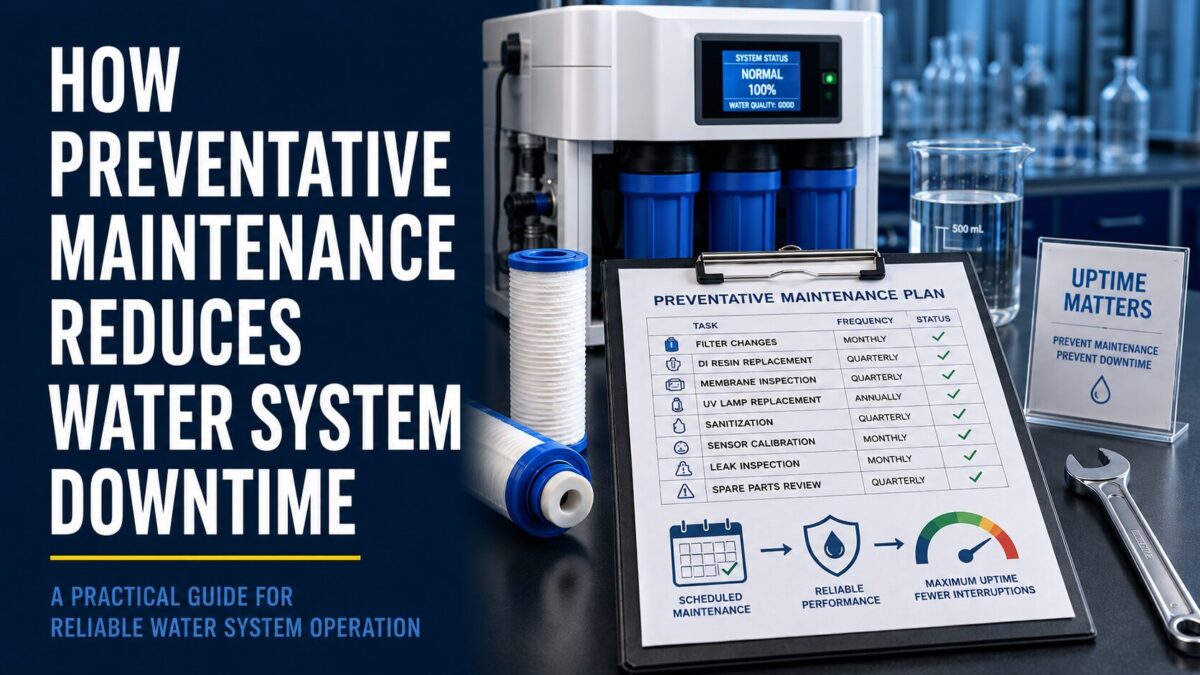
A water purification system rarely fails all at once.
More often, performance starts to slip gradually. Flow rates drop. Filters load faster than expected. Conductivity begins to rise. Pumps run longer. Alarms appear more often. By the time the problem becomes obvious, the system may already be affecting production, testing, cleaning, or other critical operations.
Preventative maintenance helps catch those problems before they turn into shutdowns.
A structured maintenance plan keeps the system operating closer to its intended performance, reduces emergency service calls, and gives facility teams more control over when service happens.
What Causes Water Purification System Downtime?
Downtime can come from a single failed component, but many outages start with smaller issues that were not addressed early.
Common causes include:
- Loaded sediment or carbon filters
- Exhausted deionization resin
- Fouled reverse osmosis membranes
- Worn pumps, valves, and seals
- UV lamp degradation
- Bacterial growth in storage or distribution loops
- Sensor drift or failed instrumentation
- Scale buildup from poor feedwater conditions
- Missed sanitization cycles
- Low inventory of replacement filters or spare parts
These issues may not stop the system immediately. They usually reduce performance over time until the system can no longer maintain the required flow, pressure, or water quality.
Preventative maintenance is designed to identify that decline early.
Maintenance Helps Catch Problems Before Failure
Routine service gives technicians a chance to inspect the system under normal operating conditions.
That makes it easier to spot changes such as:
- Increasing pressure drop across filters
- Declining membrane rejection
- Reduced product water flow
- Higher conductivity or total organic carbon readings
- Unusual pump noise or vibration
- Leaks around fittings, housings, and valves
- Frequent cycling or longer run times
- Changes in storage tank recovery
- Calibration drift in sensors and monitors
A small correction made during scheduled service is usually less disruptive than an emergency repair after the system goes offline.
For example, replacing a filter during a planned maintenance window may require only a brief interruption. Waiting until the filter is fully blocked can cause low flow, pump strain, poor water quality, and an unplanned shutdown.
Scheduled Service Makes Downtime More Predictable
Not all downtime can be eliminated.
Filters still need to be changed. Membranes eventually need replacement. UV lamps have service lives. Tanks and distribution loops may need sanitization.
The main benefit of preventative maintenance is that these tasks can happen on a schedule rather than during an emergency.
Planned maintenance can be coordinated around:
- Production schedules
- Testing cycles
- Facility shutdowns
- Staff availability
- Low-demand periods
- Required validation or quality checks
This gives operations teams time to prepare backup water, notify users, and schedule the work when the impact will be lowest.
Emergency service does not offer that flexibility.
Routine Maintenance Protects Water Quality
Downtime is not always a complete system shutdown.
A system may continue producing water that no longer meets the required quality standard. In some facilities, that can be just as disruptive as a mechanical failure.
Poor water quality can lead to:
- Failed test results
- Repeated cleaning or rinsing
- Contaminated glassware
- Instrument fouling
- Rejected batches
- Process inconsistency
- Delayed research or production
- Extra quality control investigations
Routine maintenance helps verify that the system is still producing the required water quality, not just that the equipment is running.
This may include checking:
- Conductivity or resistivity
- Total organic carbon
- Microbial control
- Membrane rejection
- Pressure and flow
- UV performance
- Filter condition
- Tank and loop cleanliness
- Instrument calibration
A system that appears operational can still create major downtime if the water does not meet the application requirements.
Maintenance Reduces Stress on Major Components
Minor maintenance items often protect more expensive components.
A clogged prefilter can restrict flow to a reverse osmosis system. Poor pretreatment can cause membrane scaling. A failed pressure control can increase pump wear. Delayed sanitization can contribute to biofilm growth throughout the distribution system.
When routine service is skipped, the system may continue running under conditions that shorten component life.
Preventative maintenance helps protect:
- RO membranes
- Pumps
- Pressure vessels
- UV systems
- Storage tanks
- Distribution loops
- Sensors and controls
- Final polishing cartridges
Replacing a lower-cost consumable at the proper interval can prevent damage to equipment that is more expensive and time-consuming to repair.
Service History Makes Troubleshooting Faster
A well-maintained system should have a clear service record.
That record can include:
- Filter replacement dates
- Sanitization dates
- Membrane performance
- Water quality readings
- Alarm history
- Calibration records
- Parts replaced
- Observed leaks or wear
- Changes in flow and pressure
- Technician recommendations
This information helps identify patterns.
If filter life is getting shorter, feedwater quality may have changed. If conductivity rises at the same point in every service cycle, the polishing stage may be undersized. If a pump has required repeated repairs, the system may have a larger hydraulic or control issue.
Good maintenance records reduce guesswork and help technicians diagnose problems faster when service is needed.
Spare Parts Planning Can Prevent Long Outages
Some of the longest shutdowns happen when a failed part is not available.
A preventative maintenance program can identify which components are most likely to interrupt operation and which parts should be kept on hand.
Depending on the system, that may include:
- Prefilters
- Carbon cartridges
- DI cartridges
- UV lamps
- O-rings and seals
- Fuses
- Solenoid valves
- Conductivity sensors
- Pump rebuild kits
- Critical control components
This does not mean storing every possible replacement part.
The goal is to identify the components that have the greatest effect on uptime, have long lead times, or can be replaced quickly by onsite staff.
Preventative Maintenance Is Not Just a Calendar
A maintenance schedule should not be based only on time.
Service intervals should reflect how the system is actually being used.
Factors that affect maintenance frequency include:
- Daily water demand
- Feedwater quality
- System recovery rate
- Number of users
- Operating hours
- Storage volume
- Distribution loop design
- Required purity level
- Seasonal feedwater changes
- Criticality of the application
- Availability of backup water
A heavily used system with difficult feedwater may need more frequent service than a lightly used system operating under stable conditions.
The best maintenance plans combine manufacturer guidance, system data, technician observations, and actual site conditions.
Signs Your System May Need More Frequent Maintenance
A system may need a revised maintenance schedule if you are seeing:
- More frequent alarms
- Falling flow rates
- Longer tank refill times
- Shorter filter life
- Increasing conductivity
- Changes in taste, odor, or appearance
- Frequent leaks
- Repeated pump or valve problems
- Higher microbial counts
- More emergency service calls
- Water quality failures between scheduled visits
These patterns suggest that the current service interval may not match the system’s operating conditions.
They can also point to an undersized system, poor pretreatment, changing feedwater, or a distribution issue.
What Should a Preventative Maintenance Visit Include?
The exact scope depends on the system, but a typical visit may include:
- Visual inspection of the full system
- Leak inspection
- Filter and cartridge evaluation
- Pressure and flow checks
- Pump and valve inspection
- Membrane performance review
- Water quality testing
- Sensor and instrument checks
- UV lamp inspection or replacement
- Tank and loop inspection
- Sanitization, when required
- Alarm and control verification
- Review of service history
- Recommendations for upcoming repairs or replacement
The most useful maintenance visits do more than replace consumables.
They also assess system performance and identify risks that could affect future uptime.
The Cost of Maintenance Versus the Cost of Downtime
The cost of preventative maintenance is usually easier to plan than the cost of an unplanned outage.
Downtime may involve more than the service call itself.
It can also lead to:
- Lost production
- Delayed testing
- Staff downtime
- Expedited shipping
- Emergency labor
- Rental equipment
- Purchased bottled or bulk water
- Failed quality checks
- Repeated cleaning
- Missed deadlines
For critical systems, one avoided shutdown may cover a large portion of the annual maintenance cost.
The exact value depends on the facility, but the basic calculation is straightforward:
Downtime cost = lost operating time + labor impact + replacement water + emergency repair cost + quality risk
A preventative maintenance plan reduces the chance that all of those costs happen at once.
Build a Maintenance Plan Around Your Operation
Water purification systems should not be maintained as isolated pieces of equipment.
The maintenance plan should reflect the process the system supports.
A reliable plan should answer:
- Which applications depend on the system?
- How long can the facility operate without purified water?
- Is backup water available?
- Which components have the longest lead times?
- Which readings should be tracked between service visits?
- Who is responsible for daily or weekly checks?
- When can planned shutdowns occur?
- What water quality documentation is required?
- Which spare parts should remain onsite?
These questions help turn maintenance from a basic service schedule into an uptime plan.
Reduce Water System Downtime With a Planned Service Strategy
Preventative maintenance cannot prevent every equipment problem.
It can, however, reduce avoidable failures, shorten repair time, protect water quality, and make service interruptions far easier to manage.
Pure Process Technology supports maintenance, troubleshooting, repairs, replacement parts, and system performance reviews for water purification systems across a range of applications.
If your system is experiencing declining flow, repeated alarms, water quality issues, or frequent service interruptions, the problem may be easier to correct before the next shutdown.
Talk with PPT today about a preventative maintenance plan for your water purification system.