
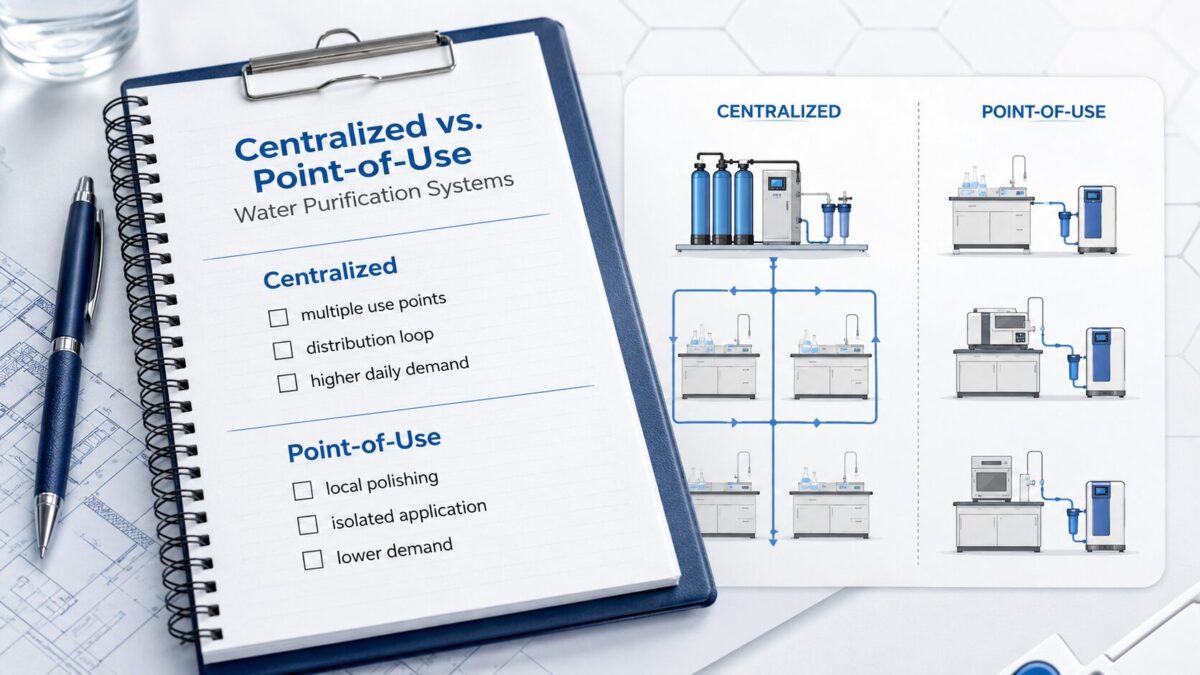
Choosing between a centralized water purification system and point-of-use equipment is one of the biggest early decisions in a laboratory or facility water project.
A centralized system produces purified water in one primary location and distributes it to multiple rooms, departments, instruments, or processes. A point-of-use system produces or polishes water close to the application it serves.
Both approaches can provide reliable high-purity water. The right configuration depends on water quality, daily consumption, peak demand, facility layout, distribution distance, maintenance plans, compliance requirements, and expected growth.
Some facilities also benefit from a hybrid design that combines central production with local polishing.
Pure Process Technology offers high-purity water purification systems for each of these approaches, ranging from compact MiniLab and QuickLab systems to high-capacity SkidSpec and sanitary SaniSpec configurations.
What Is a Centralized Water Purification System?
A centralized water purification system produces treated water from a main equipment location. The water is typically stored in a reservoir and distributed through piping to several points of use.
A central system may include:
- Feedwater pretreatment
- Reverse osmosis
- Deionization or electrodeionization
- Storage
- Distribution pumps
- Recirculating piping
- Ultraviolet treatment
- Final filtration
- Water quality monitoring
- Automated controls
Central systems are commonly used when multiple laboratories, departments, instruments, or production processes require a dependable supply of purified water.
The system may produce RO, DI, ASTM Type II, ASTM Type III, USP Purified Water, or another specified water quality.
For larger facilities, PPT’s SkidSpec water purification system can be engineered around the required flow, storage, treatment process, monitoring, controls, and distribution needs.
What Is a Point-of-Use Water Purification System?
A point-of-use system is installed close to the location where purified water is dispensed or consumed.
It may treat incoming tap water directly, receive pretreated water from another source, or polish centrally produced water to a higher purity level.
Common point-of-use applications include:
- An individual research laboratory
- A small group of nearby users
- Analytical instruments
- General laboratory preparation
- Glassware rinsing
- Buffer and media preparation
- Isolated equipment
- Final polishing for ASTM Type I water
Point-of-use equipment can be a practical choice when water demand is limited, only a few locations require purified water, or the building cannot support a large distribution loop.
PPT’s MiniLab system is designed for compact, low-demand applications requiring dependable ASTM-grade water.
For mid-volume laboratory demand, the QuickLab RODI water purification system provides a compact turnkey platform with several available configurations.
Centralized and Point-of-Use Systems Are Not Always Opposites
Many facilities use both.
A central system may produce and distribute RO or ASTM Type II water throughout the building. Local polishing units can then produce ASTM Type I water for sensitive analytical work.
This arrangement prevents the facility from treating every gallon to the highest purity level when only a few applications need it.
A hybrid configuration may include:
- Central pretreatment and reverse osmosis
- Central storage and distribution
- RO or Type II water supplied to several rooms
- Local polishing at applications requiring Type I water
- Dedicated treatment for equipment with unique requirements
The better question is often not whether a facility needs centralized or point-of-use treatment. It is where each purification stage should occur.
When Does a Centralized Water System Make Sense?
A centralized system is often a strong fit when several areas have similar water requirements or total demand exceeds what small local systems can support efficiently.
Multiple Departments Need Purified Water
Producing water from one location may be more practical than installing separate purification systems throughout the facility.
A central system can supply:
- Laboratory dispensing points
- Glassware washers
- Autoclaves
- Environmental chambers
- Process equipment
- Cleanroom applications
- Equipment rinse stations
- Feedwater for ultrapure polishing systems
Central production can also help standardize water quality, monitoring, maintenance, and documentation across the facility.
Daily Water Demand Is High
Larger facilities may use hundreds or thousands of gallons of purified water per day.
Operating numerous small systems can create unnecessary maintenance, inconsistent water quality, and limited capacity during peak operating periods.
A centralized system can be designed around:
- Average daily consumption
- Peak hourly demand
- Simultaneous use
- Required recovery rate
- Available storage
- Distribution pressure
- Operating schedule
- Future expansion
Storage allows the purification equipment to produce water steadily and cover shorter periods of heavy demand.
For more detailed planning, read How to Size a Lab Water Purification System.
The Facility Needs a Distribution Loop
A properly designed distribution loop can deliver purified water to multiple locations and continuously return unused water to storage or treatment.
Recirculation can help reduce stagnation and support more consistent water quality throughout the system.
Loop design may need to account for:
- Pipe material
- Flow velocity
- Pressure
- Dead legs
- Sanitization
- Temperature
- Microbial control
- Sampling locations
- Monitoring points
- Future connections
The purification equipment, storage tank, pumps, and piping must function as one connected system.
PPT’s SkidSpec platform is intended for high-capacity and custom-engineered applications where treatment and facility infrastructure must be planned together.
Centralized Maintenance Is Preferred
A central system gives facility personnel one primary equipment location to inspect and maintain.
This can simplify:
- Filter replacement
- Sanitization
- Consumable management
- Calibration
- Alarm response
- Water quality testing
- Preventive maintenance
- Service records
A centralized system may have fewer purification units, but the distribution network introduces its own maintenance and monitoring requirements.
PPT provides water purification system service and support for planned maintenance, audits, sanitization, troubleshooting, and system upgrades.
When Does Point-of-Use Purification Make Sense?
Point-of-use systems can be a better fit when demand is smaller, use points are isolated, or each area has different water requirements.
Only One or Two Locations Need Purified Water
Installing a building-wide distribution loop may not make sense when purified water is only needed in one laboratory or at one instrument.
A compact point-of-use system can reduce:
- Distribution piping
- Building modifications
- Installation labor
- Construction disruption
- Mechanical-room requirements
- Project coordination
For low-demand applications, a MiniLab may provide the required ASTM-grade water in a compact footprint.
A Laboratory Has Moderate Water Demand
Some laboratories need more capacity than a small point-of-use unit can provide but do not need a large centralized skid.
The QuickLab system is designed for mid-volume laboratory water requirements. Its compact, turnkey format can serve a dedicated laboratory, a group of nearby applications, or a smaller shared water network.
Available QuickLab configurations allow the system to be matched more closely to required production capacity and treatment needs.
Different Applications Need Different Water Qualities
Not every laboratory process needs ultrapure water.
Examples include:
- Glassware rinsing may use RO or Type III water.
- General reagent preparation may use Type II water.
- Sensitive analytical testing may require Type I water.
- Certain process equipment may have a manufacturer-defined feedwater specification.
Producing the highest purity water for every application can increase operating cost, consumable use, and system complexity.
Read Type I vs. Type II vs. Type III Water: What Does Your Lab Actually Need? for a detailed comparison of laboratory water grades.
Adding Distribution Piping Is Not Practical
Existing facilities may have limited pipe routes, crowded ceilings, restricted mechanical space, or occupied laboratories that cannot tolerate major construction.
Point-of-use equipment can provide purified water without installing a long distribution loop.
This is particularly useful when use points are widely separated or a single department is being renovated independently from the rest of the building.
Demand Is Low or Intermittent
A centralized system may be oversized for an application that consumes only a small amount of water.
Local systems can support intermittent demand without continuously maintaining a large storage and distribution network.
System selection still needs to account for periods of inactivity, sanitization, storage volume, and potential microbial growth.
Which PPT System Fits Each Approach?
PPT offers several water system platforms for different capacity, purity, layout, and compliance requirements.
| Facility requirement | Likely PPT starting point |
|---|---|
| Compact, low-demand laboratory application | MiniLab |
| Mid-volume laboratory or several nearby use points | QuickLab |
| High-capacity central system or distribution loop | SkidSpec |
| USP or cGMP sanitary water application | SaniSpec |
| RO reject-water recovery | Reclaim |
| Unusual process, integration, layout, or control requirements | Custom Engineered Solutions |
These are starting points rather than automatic selections.
The final recommendation should be based on feedwater quality, required purity, daily demand, peak use, storage, distribution, available space, service access, controls, documentation, and future plans.
What About USP and cGMP Water Systems?
Pharmaceutical, biotechnology, healthcare, and other regulated facilities may need more than standard RO or DI treatment.
A sanitary water system may need:
- Sanitary components
- Compatible piping materials
- Recirculating distribution
- Controlled flow and pressure
- Sanitization provisions
- Water quality instrumentation
- Automated controls
- Documentation
- Sampling locations
- Validation support
- FAT and SAT coordination
PPT’s SaniSpec USP water system is designed for sanitary water applications built around USP and cGMP requirements.
Centralized versus point-of-use remains part of the planning process, but sanitary design, documentation, sanitization, and compliance requirements may determine the final architecture.
Key Factors to Compare
A system should be selected from the full operating profile rather than equipment capacity alone.
1. Required Water Quality
Define the required water quality for every application before selecting equipment.
Specifications may include:
- Conductivity
- Resistivity
- Total organic carbon
- Microbial limits
- Endotoxin
- Particulate limits
- Silica
- Hardness
- Chlorine
- USP requirements
- ASTM or CLSI classifications
- Equipment-manufacturer requirements
Treating water beyond the actual requirement can add cost and complexity. Producing water below the requirement can affect research, equipment performance, cleaning, production, or compliance.
2. Daily and Peak Demand
Daily water consumption does not tell the whole story.
Two facilities may each use 500 gallons per day but have very different demand patterns. One may consume water gradually across two shifts. Another may use most of its water during a short production window.
Document:
- Total daily demand
- Maximum hourly demand
- Simultaneous demand
- Largest individual draw
- Batch volumes
- Operating hours
- Required refill time
- Available storage
Storage and production capacity must work together.
3. Number and Location of Use Points
Map every planned dispensing point, instrument, washer, process connection, and piece of equipment.
For each location, document:
- Required purity
- Average volume
- Peak flow
- Frequency of use
- Required pressure
- Connection type
- Operating schedule
Several nearby use points may be well suited to a QuickLab or small shared system. A large number of use points spread across a facility may point toward a SkidSpec and distribution loop.
4. Distribution Distance
Purified water quality can change after it leaves the treatment equipment.
Long piping runs can create concerns related to:
- Stagnation
- Microbial growth
- Pressure loss
- Unsuitable pipe materials
- Dead legs
- Sanitization
- Leaching
- Temperature
- Remote sampling
A high-quality purification system cannot compensate for poor distribution design.
5. Available Space
Central systems may require space for:
- Purification equipment
- Pretreatment
- Storage tanks
- Distribution pumps
- Controls
- Electrical panels
- Service access
Point-of-use systems need space near the application. Several local systems can consume laboratory bench, wall, cabinet, or floor space.
Equipment placement should allow technicians to replace filters, service pumps, access controls, and remove components without dismantling the surrounding room.
6. Maintenance Responsibilities
A central system concentrates maintenance in one location. Multiple point-of-use systems spread maintenance across several rooms.
Compare:
- Number of systems
- Consumable replacement schedules
- Sanitization procedures
- Calibration requirements
- Water testing
- Operator training
- Spare-parts needs
- Service access
- Downtime risk
Facilities seeing declining output, inconsistent purity, alarms, or rising maintenance needs should review Signs Your Water Purification System Needs Maintenance or an Upgrade.
7. Redundancy and Downtime
A centralized system may create a single point of failure. One shutdown could affect several departments.
Point-of-use systems limit the impact of one equipment failure, but each critical application may need its own backup plan.
Possible redundancy measures include:
- Duplex pumps
- Parallel treatment trains
- Emergency storage
- Backup purification units
- Spare consumables
- Temporary water connections
- Bypass provisions
The right level of redundancy depends on the operational cost of losing purified water.
8. Future Expansion
Plan for realistic growth such as:
- Additional staff
- New instruments
- More production shifts
- New laboratories
- Expanded cleanrooms
- Higher daily demand
- Stricter water specifications
- New distribution points
A centralized system may be easier to expand when additional capacity and connections are included in the initial design.
Point-of-use equipment supports gradual expansion by allowing systems to be added as new needs arise.
9. Water Recovery and Operating Cost
Reverse osmosis systems produce a purified product stream and a reject stream.
Depending on feedwater conditions and facility operations, some reject water may be suitable for another approved use.
PPT’s Reclaim water recovery system is designed to recover and reuse RO reject or rinse water, helping reduce water consumption and wastewater volume.
Water recovery should be evaluated as part of the broader system design rather than treated as an afterthought.
Centralized vs. Point-of-Use Cost
The full cost comparison should include equipment, installation, operation, service, and downtime.
Centralized System Costs
A centralized project may require:
- Larger purification equipment
- Pretreatment
- Storage
- Distribution pumps
- Piping
- Controls
- Electrical work
- Monitoring
- Commissioning
- Sanitization provisions
- Building modifications
The initial investment may be higher, but the facility may gain centralized maintenance and fewer individual treatment units.
Point-of-Use System Costs
A point-of-use approach may require:
- Several individual systems
- Separate pretreatment
- Local storage
- Multiple plumbing connections
- Multiple electrical connections
- Separate consumables
- Repeated maintenance visits
Point-of-use systems may cost less for a small application. Costs can increase when many separate units are installed across a facility.
A lifecycle comparison should include:
- Initial equipment
- Installation
- Consumables
- Water waste
- Electricity
- Maintenance labor
- Sanitization
- Replacement equipment
- Downtime
- Expected system life
Common Planning Mistakes
Selecting Equipment Before Mapping Demand
Do not select a purification unit until the facility understands where water is used, how much is needed, and what quality each application requires.
Supplying Every Application With the Highest Purity
Match water quality to the actual application. Treating all water to Type I quality usually adds expense without improving lower-purity processes.
Ignoring Storage and Distribution
Purification, storage, pumps, and distribution piping must be designed as one system.
Looking Only at Purchase Price
A lower equipment price may be offset by consumables, service labor, wasted water, construction, or lost production.
Forgetting Maintenance Access
A system that fits inside a room is not necessarily serviceable. Allow enough clearance for filters, pumps, membranes, UV lamps, tanks, instruments, and controls.
Leaving No Capacity for Growth
A system sized too closely to current demand may need costly modifications soon after installation.
The Lab Water System Specification Checklist for Engineers provides a more detailed list of planning inputs that should be documented before a system is specified.
Questions to Answer Before Choosing a System
Before requesting a proposal, confirm:
- How many locations need purified water?
- What water quality does each application require?
- How much water is consumed each day?
- What is the highest short-term demand?
- Which use points operate at the same time?
- How far apart are the use points?
- Is there room for central equipment and storage?
- Can purified-water piping be installed?
- Who will maintain the system?
- What happens during a shutdown?
- Is sanitary design required?
- Are validation or documentation requirements involved?
- Is the facility expected to expand?
- Could RO reject water be recovered?
Clear answers make it easier to compare MiniLab, QuickLab, SkidSpec, SaniSpec, and custom configurations.
Get Help Selecting the Right Water System
There is no universal answer to the centralized-versus-point-of-use question.
A small laboratory may only need a compact MiniLab. A mid-volume research facility may be better served by a QuickLab. A larger building with several departments and a distribution loop may require a custom SkidSpec. Regulated sanitary applications may call for a SaniSpec configuration.
Pure Process Technology helps laboratories, engineers, contractors, facility teams, and process users review water quality, demand, storage, distribution, controls, maintenance, compliance, and future capacity before equipment is specified.
Not sure which approach fits your facility? Request a water system spec review and have PPT review your application, facility layout, water requirements, and project goals.