
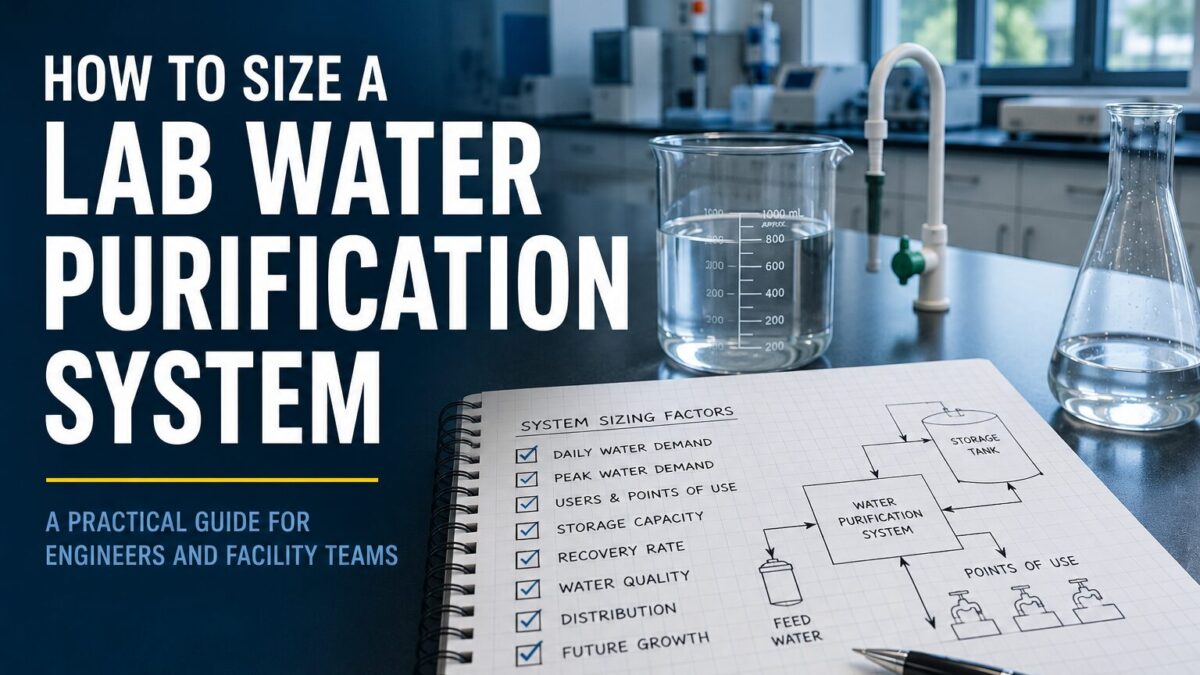
Choosing a lab water purification system is not just a matter of matching a gallon-per-day rating to an estimated total. A properly sized system must produce the required water quality, keep up with normal daily use, support periods of peak demand, and provide enough storage without creating unnecessary cost or complexity.
A system can meet the laboratory’s total daily water demand on paper and still fall short during the busiest part of the day. It can also be sized far beyond actual needs, leading to wasted space, higher capital costs, poor tank turnover, and added maintenance.
The right sizing process looks at how water is used, when it is used, where it must go, and how the laboratory may change over time.
Start With Total Daily Water Demand
The first step in lab water system sizing is estimating how much purified water the facility uses during a normal operating day.
Account for every regular use, including:
- Laboratory sinks and dispensing points
- Glassware washers
- Autoclaves and sterilizers
- Humidification systems
- Environmental chambers
- Clinical analyzers
- Reagent preparation
- Media preparation
- Equipment rinsing
- Process skids or pilot equipment
- Cleaning and sanitation cycles
Do not rely only on current purchase records for bottled or carboy water. Those records may not capture water that is rationed, work that is delayed, or equipment that is not being operated at full capacity.
A basic planning calculation is:
Estimated daily demand = total average water use from all users and equipment during one operating day
Once that figure is established, add a reasonable planning allowance for variation, unusual operating days, and near-term growth. The planning allowance should reflect actual facility plans rather than an arbitrary oversized number.
Measure Peak Water Demand, Not Just Daily Use
Peak demand is often more important than total daily demand.
A laboratory may use 150 gallons over an eight-hour shift but need 40 gallons during a short morning window. A system sized only around the 150-gallon daily total may not be able to deliver those 40 gallons when they are needed.
Peak demand can come from:
- Multiple users dispensing water at the same time
- A glassware washer filling during other laboratory work
- Autoclave cycles
- Batch preparation
- Cleaning procedures
- Shift changes
- Equipment startup
- Several points of use operating at once
Document the largest expected demand during a 15-minute, 30-minute, or one-hour period. This helps determine the required production rate, storage volume, pump capacity, and distribution design.
Ignoring peak water demand is one of the most common sizing mistakes.
Count Users and Points of Use
The number of people using purified water matters, but the number of active points of use may matter more.
Ten users working from one dispensing point create a different demand profile than ten users spread across six rooms. Each additional point of use can affect:
- Simultaneous flow requirements
- Distribution piping
- Pressure requirements
- Recirculation design
- Pump selection
- Sanitary design
- Monitoring requirements
Map every planned outlet and identify how often it will be used. Note which outlets may operate at the same time and which need a specific flow rate.
A small laboratory with limited demand and only a few outlets may be well suited to compact lab water systems. A larger facility with several departments, process connections, or distribution loops may need custom engineered lab water systems.
Identify Every Piece of Equipment the System Will Serve
Equipment demand should be confirmed from manufacturer documentation whenever possible. Avoid estimating solely from inlet pipe size or general equipment type.
For each device, record:
- Required water purity
- Average water use
- Maximum fill rate
- Batch volume
- Number of cycles per day
- Operating schedule
- Minimum pressure
- Maximum temperature
- Required connection type
- Any special sanitization needs
Some equipment uses a small amount of water continuously. Other equipment draws a large volume in a short period. These demand patterns affect system sizing in very different ways.
Equipment schedules also matter. Two high-demand devices may be manageable when operated at separate times but create a major peak when run together.
Match Production and Recovery Rate to the Workday
A purification system’s production rate describes how quickly it can make purified water under defined operating conditions. The actual output may vary with feedwater temperature, pressure, quality, membrane condition, and pretreatment performance.
Production capacity should be high enough to:
- Replace the water used during normal operation.
- Refill storage after periods of peak demand.
- Recover before the next major demand period.
- Support longer or busier operating days.
- Maintain capacity as filters and membranes approach service intervals.
A storage tank can support short bursts of demand. It does not correct a production system that cannot recover over the full operating day.
For example, a laboratory may draw heavily from storage during the morning. The purification system must then refill that storage before the next high-demand period. A low recovery rate could leave the tank partially depleted for the rest of the day.
System capacity should be evaluated as a complete cycle of production, use, storage depletion, and recovery.
Size the Lab Water Storage Tank Around the Demand Pattern
The lab water storage tank acts as a buffer between purification production and actual use.
Tank sizing should account for:
- The largest expected short-term draw
- System recovery rate
- Time available for recovery
- Emergency reserve needs
- Minimum operating level
- Pump protection
- Tank turnover
- Sanitation requirements
- Available floor space
- Distribution loop volume
The tank does not always need to hold an entire day of water. In many systems, the purification equipment produces water throughout the day and replenishes the tank between demand periods.
A tank that is too small can lead to low-level alarms, pressure loss, interrupted equipment cycles, and system downtime.
A tank that is too large can create longer water residence time, poor turnover, added footprint, higher purchase cost, and more surface area to sanitize.
Usable tank volume also differs from the tank’s listed total volume. Allowance may be needed for minimum operating levels, overflow protection, headspace, and pump controls.
Account for Distribution Distance and Flow
Producing enough water is only part of the design. The system must also deliver that water to every point of use at the required pressure and flow.
Distribution planning should review:
- Total piping length
- Pipe diameter
- Number of outlets
- Elevation changes
- Simultaneous flow
- Return-loop configuration
- Pump capacity
- Pressure drop
- Materials of construction
- Dead legs
- Sanitization method
- Temperature requirements
A system feeding one nearby outlet has very different hydraulic requirements from a system serving several floors or multiple laboratory wings.
Long piping runs and high simultaneous demand may require a larger distribution pump, pressure controls, a recirculating loop, or separate distribution zones.
Review Feedwater Quality
System output ratings are often based on specific inlet conditions. Actual facility water may not match those conditions.
Feedwater testing can identify factors such as:
- Hardness
- Chlorine or chloramine
- Conductivity
- Silica
- Iron
- Organics
- Suspended solids
- Microbial load
- Water temperature
- Inlet pressure
- Seasonal variation
Feedwater quality affects pretreatment selection, membrane performance, recovery, reject-water volume, maintenance intervals, and the stability of final water quality.
Cold feedwater can reduce membrane production. High hardness can increase scaling risk. Chlorine, chloramine, iron, and suspended solids may require added pretreatment.
A system should be sized using realistic facility conditions rather than ideal catalog conditions.
Define the Required Water Purity
Different laboratory applications may require different levels of purified water. The entire system should not automatically be designed around the highest purity required at one outlet.
Document the purity target for each use, including:
- Conductivity or resistivity
- Total organic carbon
- Microbial limits
- Endotoxin limits
- Particle control
- Chemical compatibility
- Documentation or validation needs
A facility may need general purified water for washing and equipment feed, with final polishing at selected points of use for more sensitive applications.
Separating bulk purification from final polishing can reduce operating cost and avoid producing every gallon to a specification that only a small part of the laboratory needs.
The purity target may also affect storage materials, piping materials, recirculation speed, monitoring, sanitization, and point-of-use filtration.
Plan for Realistic Future Growth
A new laboratory water system may remain in service for many years. Sizing only for the first day of operation can create an early replacement or expansion problem.
Review plans for:
- Additional laboratory staff
- New instruments
- Added shifts
- New production lines
- Facility expansion
- Increased batch sizes
- Added points of use
- New purity requirements
- Higher sanitation frequency
Future capacity should be based on credible plans. Oversizing for undefined possibilities can create its own problems.
A useful approach is to design the system so selected components can be expanded later. This may include space for a larger storage tank, extra distribution connections, modular purification capacity, or controls that support future equipment.
The Risks of Undersizing
An undersized laboratory water system may cause:
- Empty storage tanks
- Interrupted testing or production
- Low pressure at outlets
- Slow equipment fill times
- Missed cleaning cycles
- Delayed laboratory work
- Heavy wear from constant operation
- Reduced recovery time
- Frequent alarms
- Emergency use of bottled water
- Early replacement or expansion costs
If an existing system is struggling to keep up, review these signs your system may need an upgrade.
The Risks of Oversizing
Larger is not always safer.
An oversized system may create:
- Higher equipment cost
- Larger utility requirements
- Unnecessary floor-space use
- Poor storage tank turnover
- Longer water residence time
- Higher sanitization volume
- Added replacement-part costs
- More complex controls
- Lower operating efficiency
The goal is not to purchase the largest system available. The goal is to build enough production, storage, and distribution capacity around the laboratory’s actual operating pattern.
A Simple Lab Water System Sizing Example
Consider a laboratory that uses approximately 120 gallons of purified water each day.
Most of the water is used between 8:00 a.m. and noon. During the busiest hour, the lab may need 35 gallons for equipment fills, preparation work, and dispensing.
A system producing 120 gallons over a full day may appear sufficient. It could still fail during that 35-gallon peak unless enough stored water is available.
The design review would need to compare:
- The 35-gallon peak draw
- Water already available in storage
- Production occurring during that hour
- Minimum reserve volume
- Time available to refill the tank
- Expected afternoon demand
- Actual feedwater conditions
This example shows why daily capacity, recovery rate, and storage must be evaluated together.
Lab Water System Sizing Checklist
Use this checklist during early planning:
Water Demand
- What is the estimated total daily water use?
- What is the busiest 15-minute, 30-minute, and one-hour period?
- Are demand estimates based on documented equipment requirements?
- Are cleaning, rinsing, and sanitation volumes included?
- Are weekend, second-shift, or extended-hour operations planned?
Users and Equipment
- How many users need water?
- How many points of use will be installed?
- Which outlets may operate at the same time?
- What flow and pressure does each device require?
- Are any new instruments planned?
Water Quality
- What purity level is required for each application?
- Does every outlet need the same purity?
- Are microbial, organic, endotoxin, or particle limits required?
- Is point-of-use polishing appropriate?
Production and Storage
- What is the rated production rate under actual feedwater conditions?
- Can the system recover before the next peak period?
- How much usable storage is needed?
- Is an emergency reserve required?
- Will the tank have healthy turnover?
Distribution
- How far will water travel?
- Is a recirculating loop needed?
- What pressure and flow must reach the furthest outlet?
- Are there multiple floors, rooms, or buildings?
- How will the piping and tank be sanitized?
Facility Conditions
- Has the feedwater been tested?
- Are inlet pressure and temperature stable?
- Is there adequate space, drainage, power, and ventilation?
- Is pretreatment required?
- Are reject-water routing and utility connections planned?
Future Growth
- Will demand increase over the next several years?
- Can the system accept added outlets or equipment?
- Is there space for added storage or production capacity?
- Would a modular design reduce future replacement costs?
Get the Sizing Right Before Purchasing
Catalog capacity is only one part of selecting a laboratory water purification system. Daily demand, peak demand, recovery rate, storage, distribution, feedwater quality, purity targets, and future expansion all need to work together.
A water system spec review can identify missing demand data, unrealistic assumptions, utility constraints, and capacity risks before equipment is purchased.
Planning a new lab or replacing an existing system? Request help sizing the system before purchasing. Pure Process Technology can review your demand, application requirements, storage needs, distribution plan, and facility conditions to help define the right system capacity.