
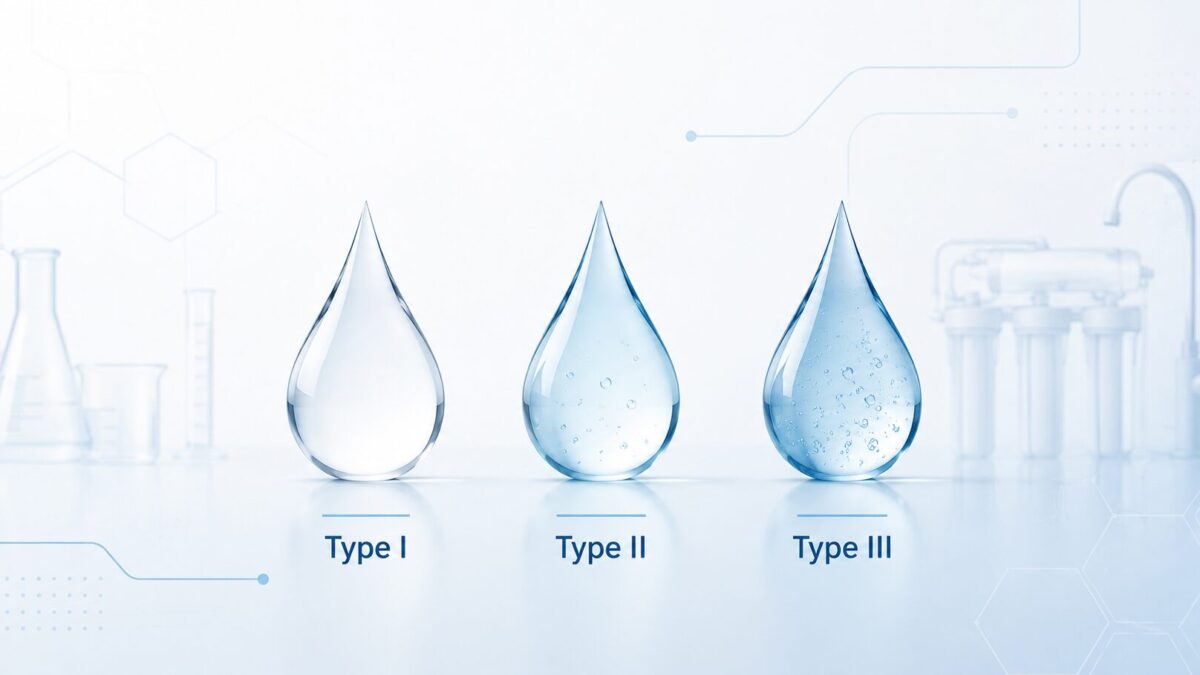
Not every lab needs the same type of purified water. This guide explains the difference between Type I, Type II, and Type III lab water so your team can match water quality to the real application.
Article Contents
- What Are Lab Water Types?
- Type I vs Type II vs Type III Comparison
- What Is Type I Lab Water?
- What Is Type II Lab Water?
- What Is Type III Lab Water?
- Why the Highest Purity Is Not Always Best
- How RO and DI Work Together
- Point-of-Use vs Central Systems
- Common Mistakes
- When to Request a Spec Review
Some applications need ultrapure water for sensitive analytical work. Others need high-purity water for general lab use, instrument support, or reagent preparation. Many labs also need purified water for rinsing, feedwater, washers, sterilizers, or other support equipment.
The mistake is assuming that “higher purity” is always the better answer.
In practice, the right lab water system depends on how the water is used, how much water the lab needs, what equipment it supports, and how the system will be maintained over time.
The goal is not to buy the purest system possible. The goal is to match water quality to the application, demand, layout, and maintenance plan.
What Are Lab Water Types?
Lab water types are purity classifications used to describe different levels of purified water. The most common categories are Type I, Type II, and Type III.
Type I Water
Generally the highest-purity option, often used for sensitive analytical work and critical applications.
Type II Water
High-purity water used for many general lab applications, reagent prep, and some equipment support.
Type III Water
Often used for rinsing, equipment feedwater, and as pretreatment for higher-purity systems.
These water types are not just labels. They help labs, engineers, and procurement teams understand what level of purification is appropriate for a specific workflow.
Type I vs Type II vs Type III Water: Quick Comparison
| Water Type | General Purity Level | Common Uses | Typical System Role |
|---|---|---|---|
| Type I Water | Highest purity | Sensitive analytical work, ultrapure applications, critical sample prep | Final polishing at point of use |
| Type II Water | High purity | General lab work, reagent preparation, buffers, some analyzers | General lab supply or feedwater for Type I |
| Type III Water | Lower purity than Type I or II | Glassware washing, rinsing, autoclave feed, general equipment support | Pretreatment, rinsing, or feedwater |
This table is a simplified starting point. Specific requirements should always be checked against your application, instrument manufacturer, facility standards, and lab procedures.
What Is Type I Lab Water?
Type I water is commonly referred to as ultrapure water. It is used for the most sensitive lab applications, especially where small amounts of contamination could affect results.
Common Type I Uses
- HPLC
- LC-MS
- ICP-MS
- Trace analysis
- Molecular biology
- Cell culture support
- Critical reagent preparation
- Sensitive sample prep
System Notes
Type I water is usually produced close to the point of use. That matters since ultrapure water can pick up contaminants from storage tanks, tubing, fittings, air exposure, and poor dispensing practices.
Type I systems may include reverse osmosis, deionization, UV oxidation, ultrafiltration, final filtration, or recirculation depending on the application. Type I water is powerful, but it is not always needed.
What Is Type II Lab Water?
Type II water is high-purity water used for many general laboratory applications. It is not typically treated as the highest-purity option, but it is often more than enough for routine lab work, reagent preparation, buffer preparation, and some equipment support.
| Use Case | Why Type II May Fit |
|---|---|
| Reagent and buffer preparation | Supports many routine lab workflows without requiring full ultrapure point-of-use production. |
| General chemistry work | Provides high-purity water for less sensitive testing and prep tasks. |
| Clinical analyzer feedwater | Can support analyzers when it matches manufacturer and lab requirements. |
| Feedwater for Type I systems | Reduces the load on final polishing stages and can support more stable Type I production. |
In many labs, Type II water is produced centrally or from a dedicated system, then used directly or fed into a Type I polishing unit. Poor Type II feedwater can shorten cartridge life, increase maintenance, and create unstable final water quality.
What Is Type III Lab Water?
Type III water is often used for less sensitive applications or as feedwater for higher-purity systems.
- Glassware washing
- General rinsing
- Autoclave feedwater
- Environmental chambers
- Equipment support
- Pretreatment for Type I or Type II systems
- Non-critical lab processes
- General facility support
Type III water may not be suitable for sensitive analytical work, but it can be a smart fit for support tasks where ultrapure water would be unnecessary and expensive.
Why the Highest Purity Is Not Always the Best Choice
It is easy to assume that Type I water is always the safest choice. That is not always true.
Higher-purity water can cost more to produce, store, distribute, and maintain. It may require more frequent cartridge changes, tighter monitoring, better materials, recirculation, sanitization, and careful point-of-use handling.
Using Type I water where Type III would work can waste money. Using Type III water where Type I is required can risk poor results, contamination, instrument issues, or failed procedures.
Questions to Ask Before Selecting a System
- What water quality does the application require?
- Is the water used for analysis, prep, rinsing, or equipment support?
- How much water is used each day?
- What is the peak demand?
- How many users need access?
- Will the system serve one instrument or several rooms?
- Does the system need storage?
- Does the lab need point-of-use dispensing?
- What does the instrument manufacturer require?
- How will the system be maintained?
How RO and DI Work Together
Many lab water systems use multiple purification steps. Reverse osmosis, deionization, carbon filtration, UV, ultrafiltration, final filtration, and storage may all play a role depending on the target water quality.
RO and DI are often used together. RO helps reduce the overall contaminant load before the water reaches the DI stage. DI then removes dissolved ions to polish the water further. This combination can improve water quality and help protect downstream cartridges.
For a deeper explanation, read our guide on how RO and DI work together.
This matters when choosing Type I, Type II, or Type III water. The water type is not only about the final number on a display. It is about the full purification path, feedwater quality, volume, storage, distribution, and maintenance plan.
Point-of-Use Systems vs Central Lab Water Systems
Some labs only need purified water at one bench or for one application. Others need a system that supports multiple users, instruments, rooms, or equipment types.
Point-of-Use Systems
For smaller or application-specific needs, point-of-use lab water systems can make sense. These systems can provide purified water close to where the water is used, which is especially useful for Type I applications.
Central Lab Systems
For larger facilities, shared labs, renovations, or high-demand environments, central lab water purification systems may be a better fit. These systems can include pretreatment, RO, storage, distribution, monitoring, and point-of-use polishing depending on the project.
System Design Factors
- Water quality requirements
- Number of users
- Daily volume
- Peak demand
- Facility layout
- Storage needs
- Distribution distance
- Maintenance access
- Redundancy needs
- Future growth
Common Mistakes When Choosing Lab Water Quality
Choosing Type I water for everything
Type I water has its place, but using it for every task can create unnecessary cost and maintenance.
Ignoring equipment requirements
Autoclaves, glassware washers, analyzers, and instruments may each have specific water quality requirements.
Forgetting about peak demand
A system may produce the right purity, but still fail to keep up with real-world usage.
Treating water quality as one fixed number
Water quality can change based on feedwater, storage, distribution, usage patterns, filters, and maintenance.
Skipping pretreatment
Poor pretreatment can shorten system life and increase consumable cost.
Planning for today only
New instruments, users, and workflows can outgrow a system that once worked fine.
When to Request a Water System Spec Review
If your lab is planning a new system, replacing an old system, adding equipment, or supporting a renovation, it may be worth requesting a water system spec review.
| Question | Why It Matters |
|---|---|
| What water type does the lab actually need? | Prevents overspending on unnecessary purity or underspecifying critical applications. |
| Should the system be point-of-use or central? | Connects system layout to real demand, users, and facility constraints. |
| Is storage needed? | Helps support peak demand without forcing the system to run beyond its design limits. |
| Is pretreatment adequate? | Protects RO membranes, DI cartridges, and downstream polishing stages. |
| Is the system planned for future growth? | Reduces the chance of early replacement or costly redesigns. |
Choosing the Right Lab Water System
Type I, Type II, and Type III water each have a purpose. Type I water supports the most sensitive applications. Type II water supports many general lab workflows. Type III water can be a smart fit for rinsing, equipment support, and feedwater for higher-purity systems.
The best system is not always the one that produces the highest purity water. The best system is the one that matches the lab’s applications, demand, layout, maintenance plan, and future needs.
Need Help Matching Water Quality to Your Lab’s Actual Use?
Pure Process Technology helps labs, facility teams, engineers, and procurement teams choose and review water purification systems based on real application needs.
If you are planning a new system, replacing an existing unit, or unsure which water type your lab needs, talk with Pure Process Technology to request a system review. Talk with Pure Process Technology