
Water Purity Standards Explained: ASTM, USP, RO/DI, and High-Purity Water Requirements
Water purification requirements can vary widely from one facility to another. A research lab, pharmaceutical facility, healthcare environment, and production space may all need purified water, but the required quality, documentation, system design, and maintenance expectations can be very different.
your guide to water purity
Understand which water type you need for your facility
This guide explains common water purity terms and standards buyers may encounter when planning a water purification system, lab water purification system, RO/DI water system, USP purified water system, or custom engineered water purification system.
If you are unsure which standard applies to your project, PPT can review your requirements and help clarify the right system path.
Why Water Purity Standards Matter
Water quality affects lab results, equipment performance, production reliability, compliance planning, and long-term system maintenance. Selecting the wrong system can lead to inconsistent purity, higher service costs, failed requirements, or avoidable downtime.
Water purity standards help define what the water needs to support. But the standard alone does not determine the full system. A proper system recommendation also depends on feedwater quality, daily usage, peak demand, storage, distribution, facility layout, documentation needs, and service expectations.
For many facilities, the best starting point is understanding the required water quality, then reviewing the full project context with an experienced water purification system supplier.
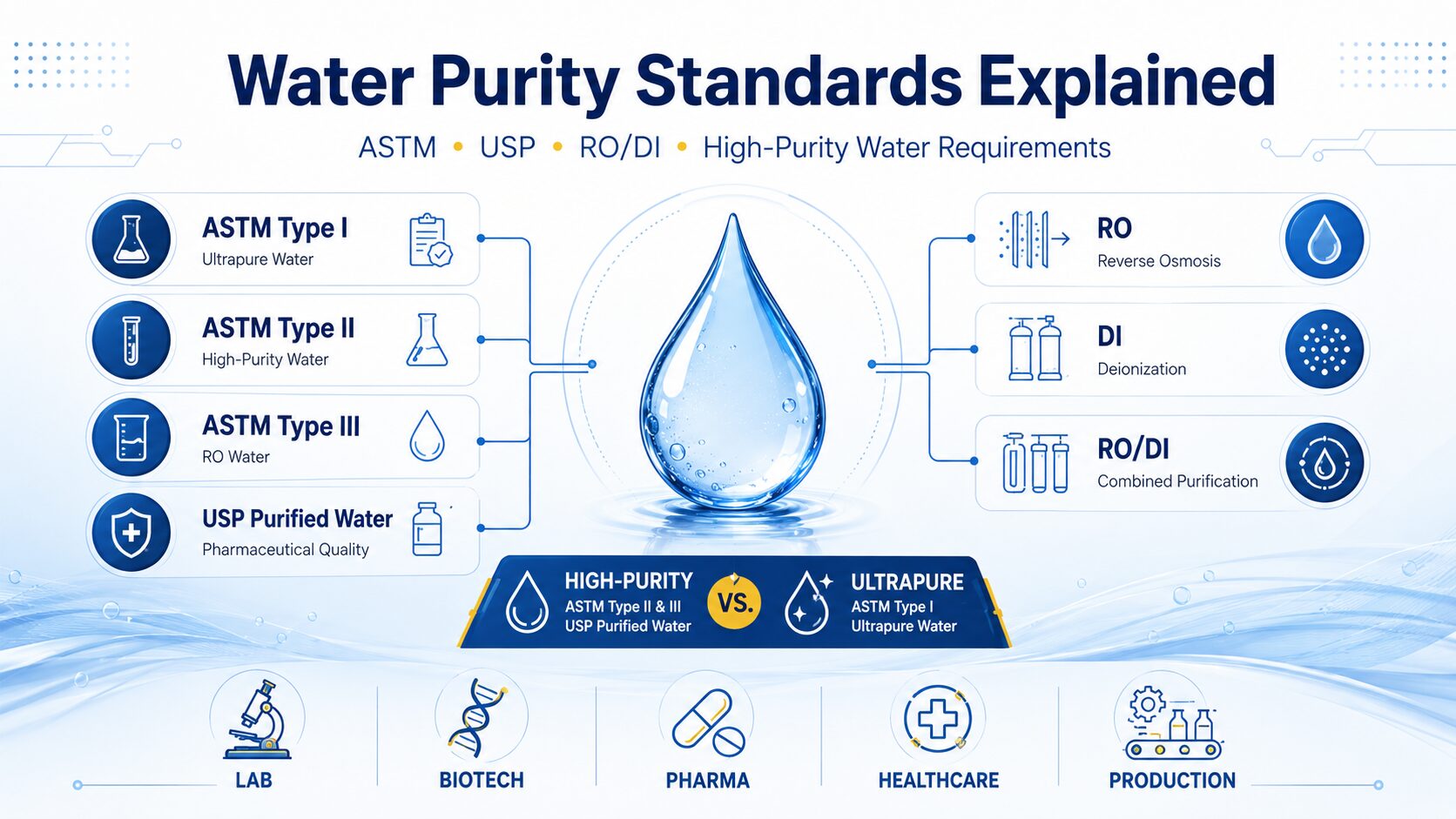
ASTM Water Types: Type I, Type II, and Type III
ASTM water types are commonly used in laboratory and technical environments to describe water purity levels. Each type supports different applications, and each may require a different system design.
ASTM Type I Water
ASTM Type I water is generally associated with the highest purity requirements in common lab water use. It is often used for sensitive analytical work, critical testing, and applications where contaminants can affect results.
Type I water may require polishing technologies, careful monitoring, and point-of-use control. Storage and distribution can also affect final water quality, so the full system design matters.
Common applications may include:
Sensitive analytical instruments
Trace analysis
Critical reagent preparation
Molecular biology workflows
Applications requiring very low ionic contamination
ASTM Type II Water
ASTM Type II water is often used for general lab applications that still require reliable purified water, but may not require the same final polishing level as Type I water.
Type II water can support many day-to-day lab workflows, including media preparation, buffers, reagent prep, and general analytical support. Depending on the application, an RO/DI water system may be part of the right system path.
Common applications may include:
General lab use
Media preparation
Reagent preparation
Buffer preparation
Feedwater for Type I polishing systems
For many labs, ASTM Type II water is less about choosing the highest purity option and more about matching reliable purified water production to daily use. PPT’s QuickLab platform may be a fit for labs that need a compact, dependable RO/DI system for general lab workflows, reagent preparation, buffers, media prep, or feedwater for final polishing.
ASTM Type III Water
ASTM Type III water is often used for general laboratory support and as feedwater for higher-purity systems. It may be appropriate for applications that need purified water but do not require Type I or Type II levels.
Type III water is often associated with RO-based treatment, but system performance still depends on proper sizing, pretreatment, maintenance, and feedwater conditions.
Common applications may include:
Glassware washers
Autoclave feed
General rinsing
Feedwater for higher-purity systems
Non-critical lab support
USP Purified Water Requirements
USP purified water is commonly associated with pharmaceutical, biotech, and regulated production environments. For these facilities, water quality is only one part of the project.
A USP purified water system may also need to account for sanitary design, documentation, storage, distribution, monitoring, cleaning, sanitization, and ongoing maintenance. Project teams may also need to plan around cGMP expectations, validation support, and long-term service access.
For USP, cGMP, or sanitary water system applications, PPT’s SaniSpec platform may be part of the system path depending on the requirements.
Common considerations include:
Water quality requirements
Sanitary materials and components
Storage and distribution design
Monitoring and controls
Documentation expectations
Maintenance and sanitization planning
Validation support needs
Facility integration
RO, DI, and RO/DI Water Explained
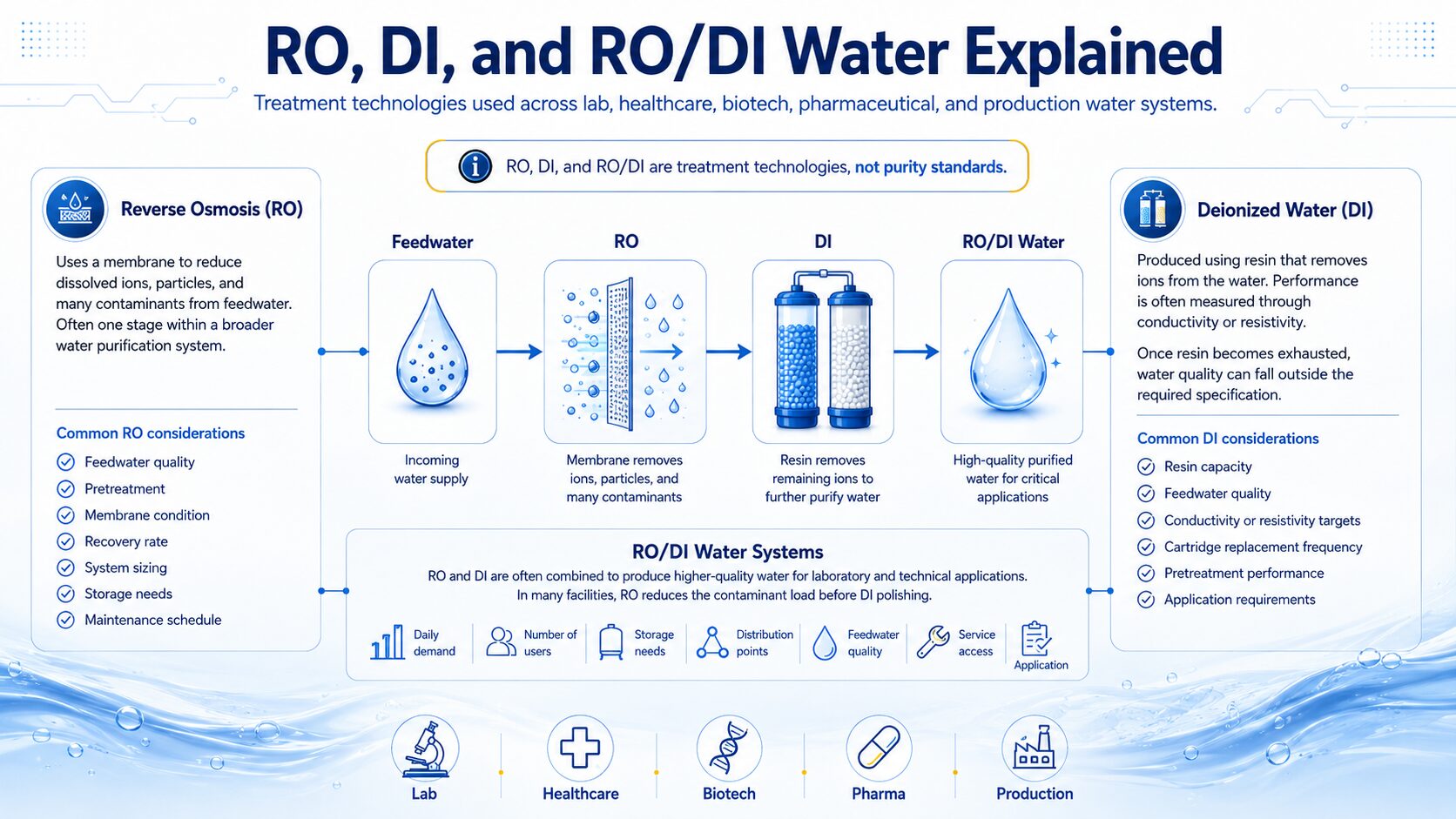
RO, DI, and RO/DI describe treatment technologies rather than a single purity standard. These technologies are often part of lab, healthcare, biotech, pharmaceutical, and production water systems.
Reverse Osmosis Water
Reverse osmosis, or RO, uses a membrane to reduce dissolved ions, particles, and many contaminants from feedwater. RO is often one stage within a broader water purification system.
RO performance can be affected by feedwater quality, chlorine or chloramine exposure, hardness, scaling, biofouling, temperature, pressure, and maintenance history.
Common RO considerations include:
Feedwater quality
Pretreatment
Membrane condition
Recovery rate
System sizing
Storage needs
Maintenance schedule
Deionized Water
Deionized water, or DI water, is produced using resin that removes ions from the water. DI performance is often measured through conductivity or resistivity.
DI resin has a service life. Once resin becomes exhausted, conductivity can rise, resistivity can fall, and final water quality may no longer meet the required specification.
Common DI considerations include:
Resin capacity
Feedwater quality
Conductivity or resistivity targets
Cartridge replacement frequency
Pretreatment performance
Application requirements
RO/DI Water Systems
RO and DI are often combined to produce higher-quality water for laboratory and technical applications. In many facilities, RO reduces the contaminant load before DI polishing.
The right RO/DI water system depends on more than a target purity level. It also depends on daily demand, number of users, storage needs, distribution points, feedwater quality, service access, and the application the water supports.
High-Purity vs. Ultrapure Water
“High-purity water” is a broad term often used for water that has been treated to remove ions, particles, organics, microbes, or other contaminants that could interfere with a process or application.
“Ultrapure water” is generally used for more sensitive applications where very low contaminant levels are required. In practice, buyers should avoid relying only on broad terms. The actual requirement should be tied to measurable parameters and the application.
Key parameters may include:
Conductivity
Resistivity
Total organic carbon, or TOC
Microbial levels
Endotoxin
Particulates
Silica
Ionic contamination
Application-specific requirements
The phrase “high-purity” can mean different things depending on the facility. A research lab, biotech facility, pharmaceutical production space, and healthcare environment may each use the term differently.
For PPT, high-purity water requirements may lead to different system paths depending on scale. A smaller lab may need a compact RO/DI platform like QuickLab, while a larger biotech, production, or multi-point facility may require a skid-mounted system such as SkidSpec with more capacity, integration flexibility, and service access.
Industry-Specific Water Requirements
Different industries use purified water in different ways. The right system path depends on how the water is used, what quality is required, and what happens if the water falls out of spec.
Academic Research Labs
Academic research labs often support many applications, users, and purity needs within one facility. A single lab may need Type I water for sensitive analytical work, Type II water for general lab use, and Type III water for glassware washers or autoclaves.
Flexibility matters in academic environments. The system may need to support changing users, new instruments, shifting research priorities, and varied points of use.
Biotech Labs
Biotech labs may depend on consistent water quality for sensitive workflows, repeatable processes, and research or production support. Water quality can affect media preparation, reagents, analytical instruments, and process reliability.
As biotech facilities scale, documentation, monitoring, maintenance, and distribution design often become more significant. A system that worked for early research may not support larger teams, higher demand, or more controlled workflows.
Pharmaceutical Facilities
Pharmaceutical facilities often have stricter water system requirements tied to USP purified water, cGMP expectations, documentation, and sanitary design.
A pharmaceutical water system may need to account for storage, distribution, sanitization, validation support, monitoring, controls, materials, and long-term service. This is where standard system selection and custom engineering need to be reviewed carefully.
Healthcare Facilities
Healthcare facilities may require reliable purified water for clinical labs, sterile processing, equipment support, or other critical applications. Requirements vary depending on how the water is used.
For healthcare environments, uptime, service access, preventative maintenance, and clear support planning can be just as important as the initial system design.
Matching the Standard to the Right Water System
A purity standard is only one part of system selection. The right system path depends on the full project picture.
PPT may review:
Required purity level
Application
Daily water usage
Peak demand
Number of users
Distribution points
Storage needs
Feedwater quality
Available space
Documentation requirements
Maintenance expectations
Timeline
Current system issues
Facility constraints
Depending on the project, the right path may involve a standard platform, a modified configuration, or a fully custom engineered solution.
Possible system paths include:
If you are unsure which system fits your requirements, PPT can review your project details and help identify the next step.
Not Sure Which Water Standard Applies to Your Project?
PPT can review your application, purity requirements, usage needs, feedwater source, documentation needs, and available specifications to help clarify the right water system path.